When Culture Becomes a Tourist Product Who Really Owns Tribal Tourism

Every December, thousands of visitors enter a valley in Nagaland to watch sixteen Naga tribes perform what their grandparents lived without scripts, tickets or applause.
The Hornbill Festival calls itself the “Festival of Festivals”. It has brought visibility, income and pride to Nagaland. It has also opened a harder question that many Naga commentators now ask in public: when ritual becomes annual spectacle, and when crowds come as much for drink, selfies and entertainment as for understanding, does the festival still belong to the communities it claims to represent?
That question is no longer limited to one festival. Across India, tribal tourism has moved from the margins of the travel industry to the centre of its imagination. Valleys, forests, rituals, food, songs, tattoos, dances, homes and ways of life have become “experiences”. They are photographed, packaged, priced and sold.
Sometimes this creates dignified income. Sometimes it helps communities preserve language, craft and ecological knowledge. But too often, the profits move outwards while the cultural cost stays inside the village.
The uncomfortable pattern is now visible from Nagaland to Andhra Pradesh, Rajasthan to the Andaman Islands. It sits inside the Hornbill Festival commercialization debate, the Araku Valley land grab, the Bishnoi safari economy and the repeatedly condemned Jarawa human safari. Together, they force India to confront a question bigger than tourism policy.
Can a living culture survive once its survival depends on being watched?
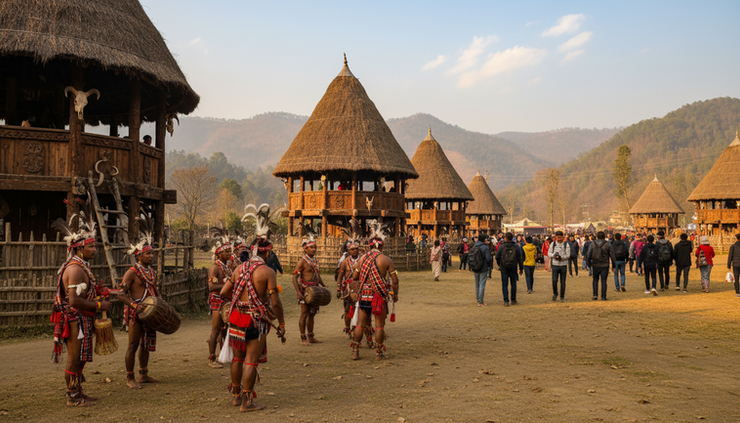
The festival stage can preserve culture, but it can also flatten it
Hornbill is not a simple villain story. That is what makes it important.
The festival has given Nagaland national and international attention. It has created an annual platform where tribes can display dance, music, food, textile traditions and ceremonial forms. For young Nagas in towns and cities, it can be a point of reconnection. For artisans and performers, it can create income. For a state often seen through conflict-heavy headlines, it offers another image.
But culture changes when it is arranged for spectators.
A ritual performed for the community carries one kind of meaning. The same act performed for tourists, time slots and cameras carries another. The steps may remain. The costume may remain. The song may remain. Yet the relationship around it changes.
In ritual life, the community decides why something happens, when it happens, who participates and what remains private. In tourism, those decisions often shift towards organisers, state agencies, sponsors, travel operators and audience expectations.
That shift may look harmless at first. A dance is shortened to fit the programme. An explanation is simplified for visitors. A sacred object is displayed because tourists expect “authenticity”. Performers repeat a ceremonial gesture several times so cameras can capture it.
Over time, the tourist version can become the version people remember.
This is the danger of indigenous culture commodification. It rarely begins with direct destruction. It begins with selection. The market rewards what is colourful, dramatic, easy to photograph and easy to explain. It ignores what is slow, private, spiritually complex or politically inconvenient.
The result is a thinner public culture, polished for outsiders.
Naga voices questioning Hornbill are not rejecting visibility. They are asking who controls the terms of visibility. That distinction matters. Communities are not museum objects. They can choose to present, adapt and celebrate their traditions. The problem begins when the choice is shaped by money, official pressure or the fear of disappearing from the tourism map.
A festival can be community-owned even when outsiders attend. But ownership must mean more than being invited to perform. It must include:
Control over what is shown and what is not shown
Fair payment for performers, cooks, guides and artisans
Space for tribal councils, elders, women and youth to shape the event
Limits on behaviour that turns cultural grounds into party zones
Serious interpretation that explains history, not just costume
The question is not whether Hornbill should exist. The question is whether it can remain accountable to the people whose name, labour and memory make it possible.
In Araku Valley, culture is not the first thing taken. Land is.
A thousand kilometres south, the romance of tribal tourism becomes harder to defend.
Araku Valley in Andhra Pradesh is often sold as a cool highland escape. Coffee, mist, winding roads, tribal museums, waterfalls and weekend resorts form the travel image. But investigative reporting has documented a darker foundation beneath parts of this tourism economy: resorts built on tribal land through benami transactions, with ownership shifted to non-tribal names to bypass protections under the Fifth Schedule.
The Fifth Schedule exists because Adivasi land is not ordinary real estate. It carries law, livelihood, ancestry and community survival. In Scheduled Areas, land protections are meant to stop exactly the kind of transfer that pushes tribal residents out while outsiders profit from the land’s scenic value.
When those protections are bypassed, tourism becomes extraction with better photographs.
The moral injury is sharp. Tribal residents who once owned or cultivated land now work inside hotels built on that land. Some work as sweepers, security guards and housekeepers. Some have done so for more than two decades. The industry may call this employment. But a wage cannot erase dispossession.
A job is not justice when it comes after land loss.
The Araku case reveals the deepest fault line in Indian tribal tourism: the industry often sells the beauty of land after separating Indigenous people from any real power over it.
This is not only a legal problem. It is a cultural one. Land holds festivals, burial grounds, shifting cultivation memories, forest routes, seed knowledge, water sources and clan histories. Once land moves out of community control, culture becomes decorative. It may still appear on resort walls, coffee labels, dance evenings and souvenir shelves. But the people who carry it become staff.
That is how tribal tourism exploitation hides in plain sight. It wears the language of development. It speaks of local employment, infrastructure and tourist footfall. It promises that remote regions will “benefit” from visitor spending.
The test should be simpler.
Who owns the land? Who signs the agreements? Who receives the long-term profit? Who can say no? Who decides what kind of tourism is allowed?
If the answer is always someone outside the community, then the project is not inclusive tourism. It is a transfer of value.

Land-based injustice also outlasts tourist seasons. A festival ends. A safari returns by evening. A resort stays. Its walls, paperwork and access roads remake the village economy.
Once a hotel comes up, land prices rise. Local food systems shift. Young people move into low-paid service work. Forest access may shrink. Water use changes. Sacred or common spaces become scenic backdrops. The village must now negotiate with a market that values appearance over belonging.
For conscious travellers, this is the hardest lesson. A beautiful stay may sit on an ugly history. A “tribal-themed” resort may be built on the very dispossession it claims to honour.
The burden cannot rest only on travellers. Visitors do not have the power to verify every land title. The law, administration and tourism industry hold far greater responsibility. Still, the public can ask better questions and refuse lazy romance.
A valley is not empty because it looks peaceful. A hill is not available because it is beautiful. A culture is not accessible because someone has printed it on a tour brochure.
The safari gaze turns people into attractions
In Rajasthan, the Bishnoi community is widely respected for a centuries-old ecological ethic. Their protection of trees and wildlife is not a branding exercise. It comes from a moral world in which nature, community and faith are deeply tied. The story of Amrita Devi and the Khejarli sacrifice, where Bishnoi villagers gave their lives to protect trees in the 18th century, remains one of India’s most powerful environmental histories.
Tourism has taken that living ecological philosophy and turned it into a fixed-price rural safari product.
A visitor can book a jeep tour, see blackbuck, watch pottery, visit weavers and eat with “local villagers”. Done responsibly, such visits can support artisans and reward conservation. But when the experience becomes staged, predictable and controlled by operators, the community risks becoming scenery in its own moral universe.
The Bishnoi example sits in a grey zone. It is not the same as violent displacement or illegal land transfer. Many families may choose to participate. Some may earn directly. Some may use tourism to sustain craft and conservation.
Yet even here, the power imbalance matters.
Who designs the route? Who sets the price? Who narrates the Bishnoi way of life? Who decides which household receives visitors? Do women and poorer families benefit, or only those connected to tour networks? Are “local lunches” paid fairly, or treated as props in the package?
When a community is known for ecological wisdom, tourism often extracts that wisdom as atmosphere. It converts ethics into experience. It invites outsiders to consume a way of life without joining its discipline.
The Andaman Islands show the most extreme version of the same gaze.
The Jarawa people, one of the Indigenous communities of the Andamans, have faced years of intrusive tourism along the Andaman Trunk Road. The Supreme Court has banned “human safaris”, and yet reports have repeatedly found attempts to circumvent the ban. Tourists have travelled through restricted areas hoping to see Jarawa people as if they were wildlife.
There is no softer phrase for this. It is dehumanising.
A human safari turns existence into spectacle. It denies privacy, consent and dignity. It treats a community’s isolation, vulnerability and difference as entertainment. It also exposes people to disease, dependency, harassment and cultural pressure.
The Jarawa case strips away the polite language often used around tribal tourism. There is no “cultural exchange” when one side watches from vehicles and the other side has not consented. There is no education when curiosity overrides law. There is no heritage appreciation when the human being becomes the attraction.

The safari gaze is not limited to the Andamans. It appears whenever travellers seek the thrill of seeing “untouched” people. It appears in requests for photos with elders, children or women in traditional dress. It appears when guides promise access to private homes without clear consent. It appears when a tourist asks someone to repeat a song, pose with a tool or dress “traditionally” for a better picture.
The camera is not neutral. Money is not neutral. Curiosity is not neutral when the person being observed has less power to refuse.
This does not mean all cultural tourism is harmful. It means the old model must end. The model where visitors arrive, watch, photograph, leave and call it understanding has failed.
A respectful model begins with the right not to be seen.
That right may sound strange in an age where visibility is treated as opportunity. But for many Indigenous communities, controlled invisibility is survival. Some ceremonies should remain closed. Some paths should remain unmarked. Some stories should be told only in the language and setting that give them meaning.
The tourist does not lose anything essential by being denied access. The community may lose a great deal by being forced open.
Parliament has named the problem, but policy must move faster than the market
In December 2025, India’s Parliament finally put the discomfort into official language. A Rajya Sabha question asked the Tourism Ministry whether tribal tourism creates unequal power dynamics and undermines community autonomy.
That question matters because the state has often promoted tribal tourism as a development good without naming its risks. Once Parliament asks about power, consent and autonomy, the debate moves from sentiment to accountability.
The Tourism Ministry pointed to a new homestay scheme under PM-JUGA, framed as a move towards community-based tourism. If designed and funded well, such schemes can shift the centre of gravity. Homestays can allow tribal families and communities to own the visitor relationship directly, rather than remain performers or low-wage staff in outside-owned properties.
But a scheme is only as strong as its control structure.
If homestay funds are delayed, captured by local elites or tied to outside platforms that take the largest share, the model will repeat older failures. If communities receive loans without legal support, marketing help, training and protection from land pressure, they may carry risk while others carry profit. If culture is still packaged to satisfy external demand, ownership will remain incomplete.
The reported gap between sanctioned funding and released money is not a small administrative detail. It tells us whether the state sees community-owned tourism as a headline or a serious alternative.
India does not lack laws and ideas. It has constitutional protections for Scheduled Areas. It has the Panchayats Extension to Scheduled Areas Act in many tribal regions. It has forest rights frameworks. It has court orders, environmental rules and district-level institutions.
The weak point is often enforcement.
Tourism grows quickly because roads, influencers, tour operators and state campaigns create demand. Consent systems move slowly. Land records remain contested. Gram Sabha approvals can be bypassed, diluted or manufactured. Local people may not have access to legal advice before agreements are signed. By the time violations surface, resorts are built, routes are popular and livelihoods are entangled.
Policy must stop treating tribal communities as beneficiaries at the end of a value chain. They must be decision-makers at the start.
A credible tribal tourism policy would include five non-negotiables.
Free, prior and informed consent
Consent must come before project approval, not after. It must be given through legitimate community institutions, in local languages, with full information about land use, revenue, environmental impact and cultural implications.
Community ownership or majority control
If tourism uses tribal land, knowledge or cultural identity, communities must hold real ownership. Token jobs, token stalls and token performances do not count.
The right to refuse access
Villages must be able to close ceremonies, sacred sites, forest paths or whole areas to tourists without being punished through funding cuts or administrative pressure.
Transparent revenue sharing
Every ticketed festival, safari, homestay network or cultural programme should show how much money reaches the community, who receives it and who decides how it is used.
Independent grievance systems
Communities need safe ways to report land grabs, harassment, underpayment, misrepresentation and photography violations. These systems must work outside the control of the same operators who profit from tourism.
Without these safeguards, “community-based tourism” becomes a comforting phrase.
With them, it can become a real path.
Travellers need a new ethic of restraint
Travel writing often teaches people how to see more. Tribal tourism demands the opposite lesson: learn when not to look.
This does not mean staying away from every Indigenous or tribal region. Blanket avoidance can also harm communities that have chosen tourism on their own terms. Many tribal cooperatives, homestays, guides, craft groups and food enterprises want visitors. They want fair income, respect and exchange.
The responsibility is to tell the difference between invitation and intrusion.
A few questions can change the moral shape of a journey:
Was this experience designed by the community or by an outside operator?
Is the money paid directly to local hosts, guides, artisans or community institutions?
Are visitors told what cannot be photographed?
Does the tour allow people to refuse interaction?
Is the culture presented as living and changing, or as frozen in time?
Does the operator explain land rights, history and present-day struggles, or only costume and food?
Are children being used as photo opportunities?
Is alcohol changing the behaviour of visitors in cultural spaces?
Would the visit still feel respectful if the camera stayed in the bag?
These questions do not make a traveller perfect. They make extraction harder.
The more difficult change is emotional. Travellers must give up the fantasy of total access. A meaningful journey does not require entering every home, recording every song or witnessing every ritual. Sometimes respect looks like buying directly from an artisan and leaving. Sometimes it looks like listening to a local guide explain why a place is closed. Sometimes it looks like choosing a duller itinerary because the thrilling one crosses an ethical line.
The best tribal tourism will not feel like consumption. It will feel like relationship, even if brief. It will include rules. It will have boundaries. It will allow hosts to be tired, private, political, modern, humorous, religious, sceptical, ambitious and ordinary.
That ordinariness matters. The tourism industry often traps tribal people inside the expectation of timelessness. It wants them traditional enough to attract visitors, but not political enough to demand rights. It wants them hospitable, but not angry. It wants their food, dance and forest knowledge, but not their claims over land, royalties and governance.
A more honest travel culture must allow tribal communities to be full societies, not curated experiences.

Ownership is more than profit
The future of tribal tourism in India will not be decided only by ministries and tour operators. It will be decided by what the country believes culture is.
If culture is a product, then the goal is simple. Package it well. Sell it widely. Keep visitors satisfied. Manage criticism as a public relations problem.
If culture is a living inheritance, the goal changes. Protect the conditions that allow it to breathe. Land. Language. Privacy. Ritual authority. Ecological continuity. Intergenerational teaching. Political autonomy. The freedom to adapt without being forced to perform an approved version of the past.
This is where inspiration must be honest. India can build a better model. The country has community institutions, legal traditions, local leadership and travellers willing to learn. There are homestays run with dignity, craft groups that keep control of their work, guides who interpret rather than exploit, and villages that welcome visitors without surrendering themselves.
But good examples cannot excuse harmful systems.
Hornbill must keep listening to Naga critics who ask whether the festival still serves the tribes or mainly the tourism calendar. Araku must confront land transfers that made Adivasi people workers on land that should never have been taken from them. Bishnoi tourism must ensure that ecological wisdom is not reduced to a jeep route. The Andamans must treat the Jarawa right to remain undisturbed as absolute, not inconvenient.
Parliament has asked the right question. Now policy, enforcement and public pressure must answer it.
The answer cannot be that tribal communities should perform better, smile wider or become more market-ready. The answer must be that tourism has to become more accountable, more patient and more willing to hear no.
A living culture does not survive because strangers watch it. It survives because its people control the ground beneath it, the stories within it and the terms on which the world may enter.


