Tirumala Darshan Tiers How Much Does Equality Cost at Rs 300

At Tirumala, the richest and most visited temple in India, equality before God now comes with a waiting time.
The free Sarva Darshan queue asks for no ticket and no fee. It also asks, on a typical day, for 15 to 24 hours of a devotee’s life. The Rs 300 Special Entry Darshan can reduce that wait to 1 to 2 hours on regular days, if the devotee has booked months in advance, watched the online quota release, and beaten thousands of others before tickets disappear. The VIP Break Darshan can take 30 to 45 minutes, and it is available through protocol to MLAs, MPs, judges, collectors, ministers, and to ordinary citizens through donations routed through the SRIVANI Trust endowment.
This is not a small administrative detail. It is a religious and moral question dressed up as crowd management.
Vaishnava devotion teaches that Lord Venkateswara is accessible to every devotee who comes with sincerity. The temple system now says access is still open to everyone, but the route depends on time, technology, status, or money. That gap between theology and queue management is where the real story begins.

Tirumala has turned darshan into a time economy
Tirumala faces a real and difficult problem. Lakhs of devotees want darshan. The sanctum cannot physically hold everyone at once. Any institution handling such numbers must regulate movement, ration access, and prevent chaos. No serious critique can ignore that.
But the question is not whether queues are necessary. The question is what principle decides who waits longer.
At Tirumala, the answer is visible in the structure:
Darshan route | Typical wait described | Access condition |
Sarva Darshan | 15 to 24 hours | Free, no ticket |
Rs 300 Special Entry Darshan | 1 to 2 hours on regular days | Online ticket, limited quota, advance booking |
VIP Break Darshan | 30 to 45 minutes | Protocol access or donation-linked access |
This is a hierarchy of time. The poorest devotee pays with a day. The middle-class devotee pays Rs 300 plus planning, internet access, and digital speed. The powerful person pays, in effect, through office. The donor pays through contribution.
All queues are not equal merely because everyone eventually reaches the deity. A person who waits under strain for 20 hours and a person who enters through a dedicated corridor after 30 minutes are both devotees, yes. But the institution has treated their bodies, time, and dignity differently.
Time is not an abstract thing. For a daily wage worker, 24 hours in a queue can mean lost income, fatigue, food costs, and the anxiety of travelling back. For an elderly devotee, it can mean physical pain. For a parent with children, it can mean exhaustion before the darshan even begins. For a person who has saved for a year to reach Tirumala, the free queue is not simply “free”. It carries a price, only the temple does not collect it at a counter.
The Rs 300 ticket looks modest to an urban professional. It is less than a restaurant meal in many cities. That is why the system appears reasonable to those who already have phones, stable internet, advance leave, and comfort with online booking.
Yet even here, the real privilege is not just Rs 300. It is information. It is timing. It is planning power. It is knowing when the quota opens. It is having decent internet when thousands of others are refreshing the same page. It is having a bank account or digital payment method ready. It is being able to commit to dates months in advance.
A temple that treats these advantages as neutral has already chosen a side.
The current system does not say the poor cannot see Lord Venkateswara. That would be crude and indefensible. Instead, it says they can see Him after sacrificing more time, more comfort, and more physical endurance. That makes inequality softer, but not less real.
The Rs 300 ticket is where the class divide becomes respectable
The Rs 300 Special Entry Darshan is the most revealing tier because it feels defensible. It is not lavish. It is not a five-star religious package. It does not sound obscene. It sounds practical.
That is precisely why it deserves scrutiny.
When an institution prices faster access low enough for the middle class, the moral discomfort reduces. People begin to say, “At least it is only Rs 300.” But the ethical issue is not the amount alone. The issue is the conversion of better religious access into a purchasable service.
At Tirumala, the Rs 300 route reportedly reduces the wait to around 1 to 2 hours on regular days. For many pilgrims, this is the difference between a manageable visit and an ordeal. When tickets are limited and vanish quickly during monthly online releases, access moves from devotion to competition. The fastest fingers, the better-connected families, and those with flexible schedules get relief. Others return to the long line.
This is why phrases such as Tirupati darshan tiers class system 2025 2026, Rs 300 special entry darshan wait time, VIP darshan Tirupati politicians MLAs, Tirupati Sarva Darshan 15-24 hours queue, temple darshan class divide India, Shirdi Vaishno Devi VIP darshan poor devotees now feel less like search terms and more like a public complaint.
People are not only looking for booking instructions. They are trying to understand how a sacred institution came to mirror the same class ladder they face outside the temple.
The defence usually comes quickly. The temple needs money. Better systems cost money. Crowd control requires categories. Pilgrims benefit from choice. Paid darshan can support services, annadanam, maintenance, and welfare.
These points cannot be dismissed. Temples are not floating in heaven. They manage kitchens, accommodation, sanitation, security, staff, transport coordination, medical needs, and infrastructure. Tirumala is a massive institution, and running it requires resources.
But a temple can raise money without making proximity feel purchasable. It can accept donations without tying them to faster access. It can charge for accommodation, transport, or special services without turning the central religious act into a graded experience.
The sanctum is not a theatre seat. Darshan is not a premium lane at an airport. A devotee does not come to consume a product. A devotee comes to be seen by the divine.
That distinction matters.
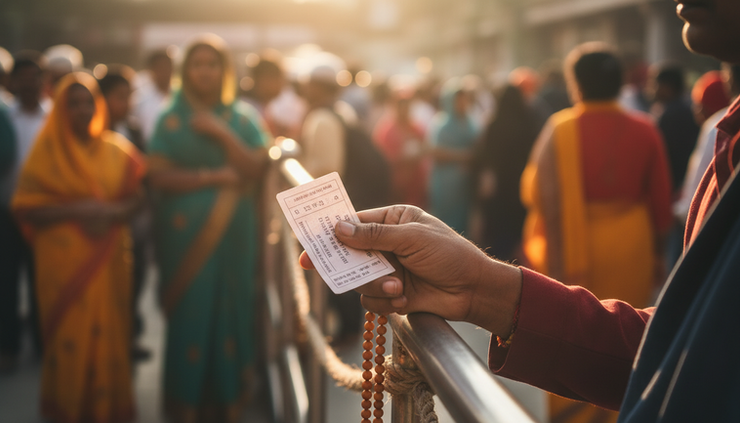
The Rs 300 tier also creates a strange emotional burden. Many devotees who take it may feel grateful, not privileged. They are not trying to exploit anyone. They may be travelling with children, elders, or limited leave. They may have saved carefully. They may see the ticket as a practical blessing.
The critique is not of the devotee. It is of the design.
A system can make ordinary people participate in inequality without making them cruel. That is the genius of respectable class systems. Nobody has to hate the poor. The structure simply makes the poor wait longer.
VIP Break Darshan makes protocol look like theology
The VIP Break Darshan is the sharpest edge of the system.
Access for constitutional authorities and public officials is often defended as protocol. Ministers, MPs, MLAs, judges, collectors, and senior officials may receive special arrangements due to security, crowd control, or official position. In a country where public figures can attract crowds, there is a practical argument for separate handling.
But protocol becomes morally unstable when it places public office closer to God than ordinary devotion.
A minister may need security. A judge may need privacy. A district official may require a controlled route. None of this automatically requires a faster, better, or more intimate darshan experience. Security can be managed without signalling spiritual priority. Public office should not become a ladder inside a temple.
The donor route raises a deeper question. If an ordinary citizen can access VIP categories through donations to an endowment, the institution may argue that the funds support dharmic work. That may be true. Donations to temples have long supported feeding, education, renovation, welfare, and religious activities.
But once the size of a donation influences the category of access, a troubling message enters the room. The wealthy devotee can convert money into time saved and proximity gained. The less wealthy devotee can offer coconuts, vows, tears, and patience, but the corridor remains different.
This is where the language of devotion collides with the mechanics of privilege.
Vaishnava bhakti has a powerful egalitarian core. The devotee approaches the Lord not by birth, wealth, or status, but through surrender and faith. The sacred stories of Hindu traditions are full of moments where simplicity defeats pride. The Lord receives the humble offering. The divine gaze does not need a donor category.
A temple administration may not deny any of this in words. It may print it in booklets, sing it in hymns, and repeat it during discourses. But the queue teaches its own theology. Every barricade, lane, ticket, and gate forms the devotee’s understanding of who matters.
The poor devotee watches certain people move faster. The child in the free queue learns the lesson before anyone explains it. The lesson is not subtle.
All are equal before God, but some reach the sanctum through a shorter corridor.
That is not a line from scripture. It is the lived religion of the queue.
No senior religious leader at India’s major pilgrimage institutions has made this the public theological crisis it deserves to be. There are regular statements on rituals, festivals, temple heritage, conversion, dress codes, and tradition. Yet charging for proximity, or linking religious access to status, rarely receives the same forceful scrutiny.
That silence has consequences. It allows administrations to frame the matter as logistics alone. It allows devotees to feel discomfort privately but not name it publicly. It allows the wealthy to see their faster access as normal. It allows the poor to treat their hardship as fate.
A living tradition should be able to ask harder questions of its own institutions.

This is not only a Tirumala problem
Tirumala is the most visible example because of its scale, wealth, and symbolic power. But the pattern extends across Indian pilgrimage.
Vaishno Devi has priority systems. Shirdi has faster darshan options. Many famous temples offer paid, special, quick, or protocol darshan under different names. The labels change. The structure remains familiar.
Free access exists, but it is slower. Paid access exists, and it is faster. VIP access exists, and it is fastest.
This system has become so common that many devotees no longer question it. They compare rates, slots, booking windows, and hacks. Families plan pilgrimages like exam registrations. WhatsApp groups circulate release dates. Travel agents know the categories. Friends advise each other on which darshan is “worth it”.
The normalisation is the real achievement. Once religious inequality becomes routine, outrage begins to look impractical. Anyone who objects is told to understand the crowd, the costs, the pressure, the scale.
The crowd is real. The costs are real. The pressure is real. The class divide is also real.
India’s temples sit at the intersection of faith, state, wealth, caste, class, tourism, and public administration. They are not private clubs. They carry civilisational meaning. They shape how millions experience dignity, belonging, and divine presence.
When a major temple creates tiered access, it does more than manage footfall. It gives social hierarchy a sacred setting.
This matters even more because pilgrimage has historically offered ordinary people a form of moral equality denied elsewhere. A worker, farmer, domestic worker, clerk, student, business owner, and judge can all stand barefoot in the same place, heads bowed before the same deity. That shared vulnerability is part of the power of a temple. It temporarily strips away worldly markers.
Tiered darshan brings those markers back in.
The smartphone enters. The online quota enters. The donation category enters. The official protocol enters. The ability to plan enters. The ability to wait without losing wages enters. The outside world walks into the temple and arranges itself neatly in front of the sanctum.
Supporters of priority darshan often say, “Those who cannot pay still get darshan.” That is technically true and morally insufficient. A public hospital cannot defend poor treatment by saying everyone eventually sees a doctor. A school cannot defend unequal classrooms by saying every child is enrolled. Access is not only about entry. It is about the conditions of entry.
Darshan is a few seconds. The experience around it is many hours. The institution controls those hours. That control must answer to dharma, not only efficiency.
A fair temple queue is possible if equality becomes the goal
The hardest part of this debate is that there is no magical solution. Tirumala cannot remove every queue. It cannot make the sanctum physically larger in a way that solves the demand. It cannot give every devotee a 30-minute wait during peak season. Any honest reform must face the numbers.
But better choices are possible.
The first step is to stop treating paid speed as the default answer to crowd pressure. A temple can manage crowds through scheduling, transparency, welfare, and fair rationing without building a moral pyramid.
Real reform could include several practical changes.
Publish daily numbers by darshan category
Devotees should know how many people entered through Sarva Darshan, Special Entry, protocol, donor-linked routes, and other categories. Transparency would make privilege visible.
Cap VIP and protocol access tightly
Security needs can be respected without allowing official status to dominate sacred space. Public office should receive logistical handling, not devotional advantage.
Separate donations from darshan priority
Let donors give generously. Honour them with receipts, public gratitude if appropriate, and the spiritual merit of giving. Do not convert donation size into faster access to the deity.
Reserve fair offline quotas
Not every pilgrim has the same digital access. A portion of time-bound darshan should be available through offline systems for those without smartphones, stable internet, or advance planning capacity.
Use lotteries instead of speed-based booking for limited slots
If demand far exceeds supply, fastest-finger booking rewards infrastructure, not devotion. A lottery can still disappoint people, but it disappoints them more fairly.
Improve the dignity of the free queue
If Sarva Darshan remains the longest route, it must be treated as the most important route, not the leftover route. Seating, water, toilets, medical support, food access, ventilation, and real-time updates are not luxuries. They are the minimum owed to devotees.
Create a theological review of access policies
Temple boards should include serious religious scholars, acharyas, pilgrim representatives, public ethics voices, and administrators who can ask whether queue design reflects the tradition’s own teachings.
None of this is anti-Hindu. It is deeply Hindu to ask whether an institution is aligned with dharma. Temples are not weakened by scrutiny. They are weakened when they become too wealthy, too powerful, or too routine to question.

A fairer system would not insult those who pay Rs 300. It would ask why relief from hardship has been priced at all. It would not shame donors. It would ask why generosity needs a faster corridor. It would not disrespect public officials. It would ask why public service should carry devotional privilege.
Most of all, it would restore clarity to the central act. Darshan should not feel like a graded entitlement. It should feel like grace.
The real cost is not Rs 300
The price of equality at Tirumala in 2026 may look like Rs 300, provided the devotee had a smartphone in May, a good internet connection, and the discipline to plan months ahead.
But the real cost is larger.
It is paid when a daily wage worker loses a day in the free queue while someone with status walks through a faster lane. It is paid when a child learns that money can shorten the road to God. It is paid when temple boards speak the language of devotion but run the machinery of class. It is paid when religious leaders stay silent because the system is too convenient to disturb.
Tirumala does not need less faith. It needs more courage from within the faith.
The devotees will keep coming. They will climb, wait, chant, pray, cry, and surrender. Their faith is not in doubt. The question is whether the institution receiving that faith can look at its own corridors and ask a simple question without flinching.
If Lord Venkateswara is equally accessible to all, why does the shortest queue still belong to power?


