The Hidden Cost of the Green Revolution in India

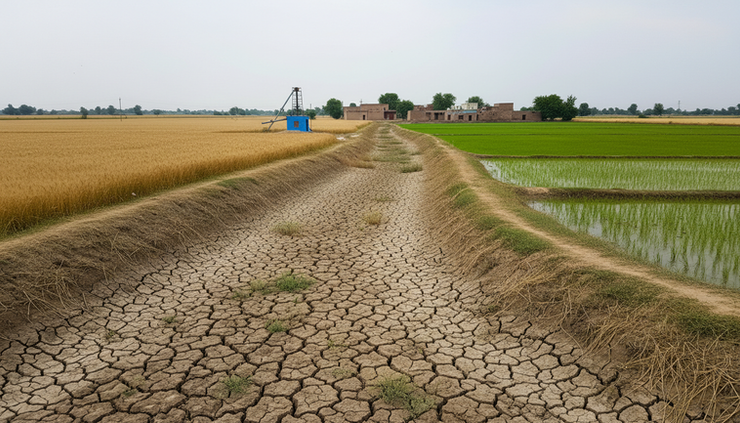
Punjab’s latest groundwater assessment contains the kind of number no school chapter can easily absorb. In 2025-26, the state extracted 26.32 billion cubic metres of groundwater against a sustainable limit of 17.29 billion cubic metres. That is 52 per cent over capacity. Out of 153 assessed blocks, 110 were over-exploited.
This is not a side note to the Green Revolution. It is one of its central consequences.
The familiar story is true. India entered the 1960s with a food crisis so severe that dependence on grain imports had become a national vulnerability. High-yielding wheat and rice varieties, backed by irrigation, fertilisers, pesticides, procurement and public research, helped the country escape famine and become self-sufficient in grain.
But the national memory kept the harvest and misplaced the invoice.
That invoice now appears in falling water tables, poisoned soils, shrinking biodiversity, debt-ridden farms and villages where medical journeys have become part of rural life. The Green Revolution did end a famine. It also rewired Indian agriculture around chemicals, monoculture and groundwater it could never sustainably repay. Both facts are true at once. Only one made it into the chapter.
The victory story is real, but it was never the whole story
To understand the cost, the achievement must be taken seriously.
Independent India inherited a fragile food system. Partition had disrupted grain-producing regions. Population growth was rapid. Droughts in the mid-1960s deepened a national emergency. India relied heavily on imports, including wheat shipments under the United States’ PL-480 programme. Food security was not an academic phrase. It was a question of sovereignty.
The Green Revolution changed that equation.
New semi-dwarf wheat varieties, especially in Punjab, Haryana and western Uttar Pradesh, responded strongly to fertilisers and irrigation. Rice followed in several regions. Public investment supported canals, electricity, extension services, agricultural universities and the Food Corporation of India’s procurement system. Minimum support prices gave farmers a reason to take risks.
Yields rose. Granaries filled. India reduced its dependence on imported grain. The political confidence of the republic grew with the food stock.
This success deserves respect. It saved lives. It gave a poor country room to breathe. It made state capacity visible in the field, not just in government files.
Yet the model had a design flaw. It rewarded output, mainly wheat and rice, while treating soil, water, seed diversity and farmer debt as background conditions. Those background conditions are now in the foreground.
A farming system is not only a machine for producing grain. It is a relationship between land, climate, seed, labour, market and memory. The Green Revolution strengthened one part of that relationship and strained the rest.
Punjab did not fail because farmers were backward. It is in crisis because farmers adopted the system the nation asked them to adopt, and then carried the costs for decades.
The lesson is not that India should have rejected science. The lesson is that science without ecological accounting creates a delayed crisis. The numbers arrive later, but they arrive.
Punjab became the granary by spending its aquifer
The Green Revolution found its showcase in Punjab for good reasons. The state had fertile alluvial soils, a strong canal legacy, enterprising farmers, better rural infrastructure and political urgency. It became the symbol of national food security.
But Punjab was not naturally suited to the rice-heavy system it later came to carry.
Rice is a water-intensive crop. Traditional rice-growing regions usually receive higher rainfall or have ecological conditions better matched to standing water. Punjab’s climate, by contrast, leans semi-arid in large parts. Its rainfall could support a different agricultural mix, but the procurement system made paddy extremely attractive. Farmers responded rationally. They grew what the state bought.
The result is the Punjab groundwater crisis.
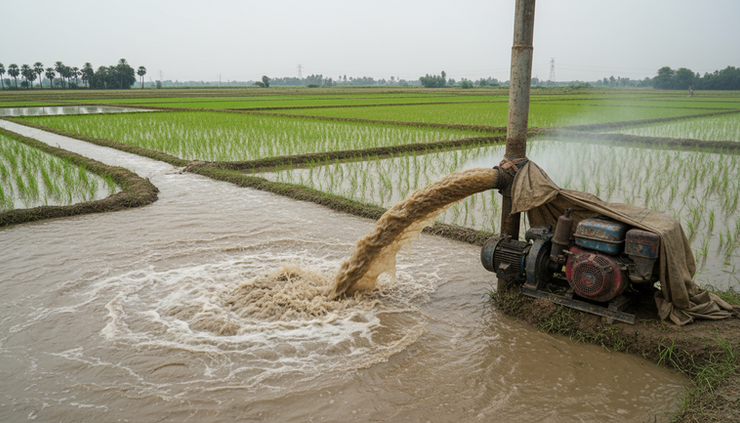
Tube wells multiplied. Free or subsidised power encouraged deeper pumping. As water tables fell, farmers installed more powerful pumps. The crop calendar changed too. Paddy transplantation often drew heavily on groundwater before the monsoon was fully established, putting more pressure on aquifers.
Groundwater is not like money in a savings account that can be restored with one good season. In many places, aquifers take centuries or millennia to form. Once overdrawn year after year, they do not recover on political timelines.
The 2025-26 assessment makes the imbalance plain:
Groundwater measure in Punjab | 2025-26 figure |
Annual groundwater extracted | 26.32 billion cubic metres |
Sustainable extraction limit | 17.29 billion cubic metres |
Extraction above capacity | 52 per cent |
Over-exploited blocks | 110 of 153 |
These figures are not just environmental statistics. They are a map of future risk.
When groundwater falls, small farmers suffer first. A wealthy farmer may deepen a borewell, buy a stronger motor or absorb a bad season. A marginal farmer cannot always do that. The ecological decline becomes an economic filter, pushing the weakest out first.
It also changes the moral meaning of food security. If grain production depends on mining water faster than nature can replace it, the surplus is partly borrowed from the future. India’s food buffer may look strong on paper, while the water base beneath it weakens year by year.
That does not make the Green Revolution a mistake. It means the model succeeded under one set of urgent conditions and then became dangerous when treated as permanent.
The same technology that rescues a country from famine can become harmful if policy freezes it in place. A life-saving intervention in the 1960s hardened into a procurement habit, a cropping pattern, a political bargain and a rural debt structure.
Punjab kept feeding India. India did not ask often enough what Punjab was losing.
The chemical bargain moved from the field to the body
The Green Revolution was not only about seeds. High-yielding varieties worked best with fertilisers, pesticides, assured irrigation and controlled crop conditions. The package raised output, but it also made chemical use part of routine farming.
Punjab, with only about 1.5 per cent of India’s land, has been reported to consume nearly a fifth of the country’s pesticides. That imbalance has shaped public anxiety across the Malwa belt, where farmers, labourers and families have long worried about exposure through soil, water, food and daily work.
Then there is the train.
Every night at around 9:30 pm, a train leaves Bathinda for Bikaner, crossing about 325 kilometres to reach the city that houses Acharya Tulsi Regional Cancer Hospital. Locals call it the Cancer Express. Roughly 60 per cent of its regular riders are said to be cancer patients, many from Punjab’s cotton and farming belt.
The phrase is not an official diagnosis. It is a social indictment.
Cancer has many causes, and no responsible account should reduce a complex disease to one factor. Genetics, lifestyle, screening, occupational exposure, water quality and access to health care all matter. But when a region known for intensive pesticide use also becomes known for cancer journeys, people are right to ask hard questions.
The Punjab cancer train became a symbol because it compresses a rural crisis into one image: patients and families travelling overnight, often after years of agricultural exposure, financial strain and limited local care.
The medical uncertainty does not erase the policy certainty. India encouraged a model that normalised heavy chemical dependence without building strong enough safety systems around it.
Those missing safeguards include:
regular monitoring of pesticide residues in soil and water
independent health surveillance in high-use districts
safer handling practices for farmers and labourers
stronger regulation of hazardous formulations
extension services that teach low-chemical pest management
health infrastructure close enough to rural populations
This is where the Green Revolution story becomes deeply human. The same farmer celebrated for feeding the nation often handled chemicals without adequate protection, bought inputs on credit and absorbed the risk of crop failure alone.
A chemical treadmill can be cruel. Pests adapt. So farmers spray more, switch products or combine chemicals. Costs rise. Ecological balance weakens. Beneficial insects decline. Soil organisms suffer. Over time, the field becomes less resilient, and the farmer becomes more dependent on the market.
The early gains were visible in yield charts. The later losses appeared in household budgets, hospital corridors and water test results.
There is another irony. The Green Revolution was sold as a triumph of modernity over scarcity. Yet its chemical dependence often reduced the farmer’s practical freedom. Seeds, fertilisers, pesticides, diesel, machinery and electricity shaped the farm plan before the season even began.
That is not prosperity. That is a high-risk production contract with nature, banks and the state, where the farmer signs first and gets paid last.

India gained grain but lost seed memory
Before modern uniform varieties took over large regions, Indian agriculture carried a vast genetic archive. Farmers cultivated rice adapted to floods, droughts, saline soils, deep water, uplands, local cuisines, rituals and seasons.
India once had more than one lakh distinct indigenous rice varieties. Fewer than 7,000 survive in any form today, and many of those are no longer grown in fields.
This is one of the least discussed costs of the Green Revolution: indigenous rice varieties lost not because farmers forgot how to farm, but because policy and markets narrowed the definition of value.
A local variety might have been less productive under ideal input conditions, but it often carried traits that mattered in real life. Some tolerated drought. Some survived floods. Some resisted local pests. Some needed fewer external inputs. Some cooked better for regional dishes. Some had cultural value in festivals and community rituals.
The new system rewarded a smaller set of traits:
high yield under irrigation
strong response to fertilisers
uniform grain
suitability for procurement
predictable maturity
compatibility with mechanised systems
These traits mattered, especially during a food crisis. But once they became dominant, diversity looked inefficient. Seed memory moved from farms to gene banks, and sometimes vanished entirely.
That loss now looks dangerous.
Climate change is making rainfall less predictable. Heat waves can damage wheat yields. Floods can destroy standing crops. New pests and diseases move across regions. In such a world, genetic diversity is not nostalgia. It is insurance.
A country with thousands of living crop varieties has more options. A country dependent on narrow genetic lines has fewer.
Seed diversity also protects culture. Food is not just calories. It is taste, identity, medicine, ritual, adaptation and local knowledge. When a farmer stops growing a traditional rice, a whole chain weakens: seed selection, cooking practice, storage method, local exchange and ecological understanding.
The Green Revolution made India more secure in one sense and more fragile in another. It filled the granary, but thinned the living library.
This is why seed savers, community seed banks, biodiversity registers and traditional growers matter. They are not museum keepers. They are future builders. Their work challenges the idea that progress must always mean uniformity.
The next agricultural transformation cannot treat diversity as a sentimental extra. It must treat it as infrastructure.
The economics turned against the farmer
The Green Revolution created a new kind of farmer, productive, market-linked and input-dependent. In the early years, this could raise incomes, especially for farmers with larger holdings and access to irrigation. Over time, the costs became harder to carry.
Studies from Punjab Agricultural University found that by the 2000s, nine in ten farmers in Punjab were in debt. Between 2000 and 2017, roughly 16,000 farmer and farm-labourer suicides were recorded in the state, with unpaid loans and small landholdings often at the centre of the crisis.
These numbers are painful because they cut through a comforting myth. The Green Revolution did not create a permanently prosperous countryside. It created a system where prosperity depended on scale, credit, water, procurement and rising input use.
For small and marginal farmers, the arithmetic became unforgiving.
A typical season could require spending before earning:
seed purchase or preparation
fertilisers and pesticides
diesel or electricity for irrigation
hired labour or machinery
land lease payments where applicable
family expenses during the growing season
interest on earlier loans
If the crop succeeded and procurement worked, the farmer survived. If prices fell, the crop failed, a pest attack spread, a borewell collapsed or a medical emergency struck, the debt rolled forward.
The farm became both workplace and collateral.
This is where Punjab farmer suicides must be understood with care. Suicide is never caused by one factor alone. Mental health, family pressure, social stigma, debt, crop loss and institutional failure can all interact. But the role of debt in agrarian distress is impossible to ignore.
The debt crisis also affected farm labourers. Landless workers depended on the same agricultural economy, but with fewer assets and weaker social protection. Mechanisation reduced some forms of labour demand. Chemical farming increased exposure risks. Rural distress did not stop at the landowner’s boundary.
The Green Revolution’s public language often honoured “the farmer” in the abstract. Its economic structure often rewarded those best placed to take risk and punished those least able to bear it.
This pattern raises a difficult policy question. Who should pay for a national food system?
For decades, farmers in Punjab and Haryana carried the burden of producing rice and wheat for national stocks. Consumers benefited from stable grain supplies. The state benefited from food security. But farmers and ecosystems absorbed hidden costs.
If the country needs grain, the country must also pay for water conservation, crop diversification, soil restoration, health monitoring and income security. A food system cannot run on gratitude speeches and underpriced natural resources.

The next revolution must repair what the first one ignored
The Green Revolution belongs to Indian history, but its repair belongs to Indian policy now.
A fair reading refuses both extremes. It does not romanticise pre-Green Revolution hunger. It does not pretend technology alone can solve every rural crisis. India needed a food breakthrough in the 1960s. India now needs an ecological and economic correction just as bold.
The good news is that the path is visible. It is not simple, but it is no longer mysterious.
Punjab and other grain-surplus regions need crop diversification that is real, not rhetorical. Farmers cannot be asked to shift away from paddy unless markets, procurement, processing and risk protection shift with them. A farmer will not abandon a guaranteed buyer for a lecture on sustainability.
Policy must make the better choice viable.
That means:
assured procurement or price support for less water-intensive crops
investment in pulses, oilseeds, millets, maize, vegetables and agro-processing
water budgeting at the block and village level
incentives for direct seeded rice where suitable
support for agroecology and integrated pest management
soil health restoration beyond token testing
community seed banks and farmer-led seed networks
rural health surveillance in high-exposure districts
debt relief and institutional credit for small farmers
income support linked to ecological transition
India also needs to rethink what it means by productivity. Yield per hectare matters, but so does yield per litre of water. So does net income after input costs. So does nutrition per acre. So does resilience after a heat wave or flood.
A farming system that produces slightly less grain but uses far less groundwater, fewer chemicals and gives farmers better net income may be more productive in the ways that matter now.
This is not a retreat from science. It is better science.
Indian agricultural research can lead the next phase by working with farmers, not merely prescribing to them. The country’s universities, Krishi Vigyan Kendras, seed savers, women farmers, farmer producer organisations and local communities all hold pieces of the answer.
The state must also reform its own incentives. As long as public procurement heavily favours rice and wheat in specific regions, farmers will follow that signal. As long as electricity and water remain politically sensitive but ecologically unpriced, groundwater decline will continue. As long as rural health data stays weak, suffering will remain anecdotal until it becomes undeniable.
The Green Revolution’s hidden costs are now visible enough to guide action.
The Punjab groundwater crisis is not just Punjab’s problem. The Punjab cancer train is not just a local tragedy. The story of indigenous rice varieties lost is not just about seeds. Punjab farmer suicides are not only private grief. Together, they show what happens when a national success is measured too narrowly for too long.
India can honour the Green Revolution without being trapped by it.
The first revolution answered the fear of hunger. The next one must answer the fear of collapse. It must grow food without draining aquifers, protect crops without poisoning ecosystems, raise yields without erasing diversity and support farmers without pushing them into debt.
The school chapter does not need to be torn out. It needs a second half.
That second half should teach that food security is not only the absence of famine. It is the presence of healthy soil, living water, diverse seeds, fair prices and farmers who can survive the season with dignity.
The Green Revolution gave India grain. The next revolution must give Indian agriculture a future.


