India’s Extraction Economy: Who Pays the Price?

Jharkhand contains about 40% of India’s coal reserves. Odisha holds 59% of India’s iron ore and 35% of its bauxite. Chhattisgarh, too, sits on coal, iron ore, limestone and other minerals central to India’s industrial machine.
These are not just mineral maps. They are also maps of Adivasi homelands.
That overlap is the core political fact behind India’s extraction economy. The same forests, hills, rivers and plateaus that sustain Adivasi communities have powered steel plants, coal-fired electricity, aluminium smelters, cement factories, highways, cities and state revenue. The wealth moves outward. The costs remain local.
Since independence, over 30 million Adivasis have been displaced by development projects, including mining, dams, highways and conservation reserves. Adivasis are around 8% of India’s population, yet a government working group has estimated that they form 40% to 50% of the roughly 60 million people displaced by development since 1947.
That is not an unfortunate side effect. It is a pattern.

Mineral wealth and Adivasi land sit on the same map
India’s extraction economy depends on a very specific geography. Jharkhand, Odisha and Chhattisgarh are not peripheral to the national economy. They are central to it. Coal, iron ore, bauxite and uranium from these regions feed the country’s energy, infrastructure and manufacturing systems.
Yet the people who live on these lands rarely experience that centrality as power.
In Jharkhand, mining for just coal, bauxite and iron ore has required the acquisition of 87,706 hectares of land, an area larger than Bengaluru. In the iron ore belt alone, displacement has affected people across 16 villages. These figures matter because they puncture the casual language of “land acquisition”. What gets acquired is not empty land. It is farmland, forest, burial ground, grazing route, stream, shrine, seed bank, memory and authority.
Region | Mineral importance | Social reality |
Jharkhand | Around 40% of India’s coal reserves, plus uranium, iron ore and bauxite | One of India’s largest Adivasi populations, with a long history of land alienation and displacement |
Odisha | 59% of India’s iron ore and 35% of its bauxite | Major Adivasi communities live in mineral-rich hill and forest areas |
Chhattisgarh | Major coal, iron ore and other mineral belts | Adivasi districts face overlapping pressures from mining, militarisation and forest governance |
The phrase “resource-rich but poor” appears often in policy debates about eastern and central India. It is too soft. These regions are not poor because they lack resources. They are kept politically weak despite their resources. The minerals are valued, priced, auctioned, transported and industrially consumed. The communities are treated as obstacles to the movement of those minerals.
This is why the phrase “geography of extraction” matters. It describes more than mining. It names a system in which state power, corporate planning, security operations, environmental clearances and compensation processes converge on specific territories, often without the people of those territories having decisive control.
The Adivasi question cannot be separated from the mineral question. Land rights, forest governance, livelihoods, federalism, climate policy, policing and India’s growth model all meet at the mine gate.
Search terms such as “Adivasi tribal displacement mining India 2025, Jharkhand Odisha Chhattisgarh mineral wealth tribes, Forest Rights Act 2006 implementation failure, Coal India Amnesty International Adivasi rights, 30 million Adivasis displaced India since 1947, Bastar Chhattisgarh Adivasi killings mining 2024 2025” may look like a list of disconnected issues, but they point to the same story: extraction has carried a human cost that official growth narratives often hide.
Displacement is not a single event
Displacement is usually imagined as a bulldozer moment. A family leaves a home, a village is relocated, a mine expands, and the story moves on.
That view misses the long violence of displacement.
For Adivasi communities, displacement can mean losing land without losing only land. It can mean losing access to forests that provided food, medicine, fuel, grazing and festival materials. It can mean losing the political authority of the gram sabha. It can mean losing a language ecology, where place names carry knowledge about seasons, animals, water and ancestors. It can mean wage dependence in a market where promises arrive before extraction and vanish after production begins.
The numbers are staggering, but the lived timeline is often worse.
A family may be told that compensation is coming. Years pass. A younger generation grows up without secure land and without the permanent jobs once promised. The mine continues to produce. Trucks keep moving. Coal reaches power plants. Iron ore reaches steel plants. Bauxite becomes aluminium. The village waits.
The case of Poonam Devi, whose family was displaced from Manjhali Dadi village in Jharkhand for a coal mine, captures this broken bargain. She received a factory job set up by the mining contractor. In 2024, the factory shut down and she lost that job. The mine continues to operate.
That contrast is the whole moral economy of extraction in one sentence. The project survives. The rehabilitation promise does not.
If compensation is delayed, partial or poorly designed, displacement becomes intergenerational. If jobs are temporary, low-paid or limited to one household member, they cannot replace community control over land and forest. If women lose access to forest produce but compensation is paid to male land title holders, the social cost expands. If the new settlement lacks water, schools, health centres or cultivable land, “resettlement” becomes a bureaucratic word for managed insecurity.
This is why rehabilitation cannot be measured only by cheques issued or houses built. A fair process must ask harder questions:
Did people have the right to say no?
Were gram sabhas given full information in a language people understood?
Were forest rights recognised before land diversion?
Did compensation reflect livelihood loss, not just titled land?
Were women, landless households and forest-dependent families counted?
Did promised jobs last as long as the project’s profits?
Were objections answered, or merely filed away?
Communities around SECL’s Kusmunda mine in Chhattisgarh, CCL’s Tetariakhar mine in Jharkhand and MCL’s Basundhara-West mine in Odisha told Amnesty International that they had been shut out of decision-making, had waited decades for promised compensation, and had received no response to formal objections filed with the Coal Controller.
That is not a paperwork problem. It is a democracy problem.

The law recognised historical injustice, but implementation has lagged
The Forest Rights Act of 2006 was supposed to mark a turn in Indian democracy. Its premise was unusually honest for a statute: forest-dwelling communities had suffered historical injustice under colonial and post-colonial forest governance.
The Act recognises individual and community forest rights. It gives gram sabhas a central role in determining claims. It matters deeply because many Adivasi communities were treated as encroachers on lands they had lived with and protected for generations. Without recognised rights, communities become easier to evict, easier to undercount and easier to ignore when forests are diverted for mining or other projects.
Nearly twenty years later, implementation remains incomplete.
The gap between law and ground reality is not accidental. Recognising forest rights can slow down or complicate extractive projects. It can strengthen gram sabhas. It can force officials and companies to deal with communities as rights-holders rather than beneficiaries. For a system built around fast clearances and high production targets, that is inconvenient.
This is exactly why implementation matters.
A land acquisition process that begins before forest rights are settled starts from a false premise. It treats the area as administratively available before the people’s legal rights have been fully recognised. That shifts the burden onto communities. They must prove what the state should already have helped document.
The same applies to consent. Under the legal and constitutional framework for Scheduled Areas, especially through the Panchayats Extension to Scheduled Areas Act, gram sabhas are not meant to function as decorative institutions. They are supposed to carry real authority over local resources and development decisions.
When consent becomes a signature exercise, the process loses legitimacy.
A meaningful consent process must include full project details, environmental and social impacts, rehabilitation terms, alternatives, and the right to reject or renegotiate. It must include women, landless families, forest produce gatherers, pastoral groups and those without formal land titles. It must happen before decisions are locked in, not after contracts are signed and machinery arrives.
The failure of the Forest Rights Act is not that the law lacks moral clarity. The failure lies in a political economy that recognises rights slowly and extracts minerals quickly.
That imbalance appears in the everyday language of administration. Production shortfalls are treated as urgent. Consent failures are treated as procedural. Delays for industry become national concerns. Delays in compensation become local grievances. A mine’s output is tracked with precision. A displaced family’s loss is negotiated, contested or forgotten.
This is how inequality gets built into the state’s operating system.
Coal, growth and the hidden subsidy of dispossession
India’s GDP does not rise from minerals alone. It rises through labour, infrastructure, finance, technology, agriculture, services and public investment. Yet mineral extraction has played a crucial role in building modern India’s industrial capacity. Coal has powered electricity. Iron ore has fed steel. Bauxite has fed aluminium. Uranium has fed strategic sectors.
The question is not whether minerals matter. Of course they do. The question is why the people living above those minerals are asked to pay such a high price for everyone else’s development.
There is a hidden subsidy in India’s growth story. It is paid through cheap land, delayed compensation, weakened consent, damaged forests, polluted water, broken community institutions and the forced movement of people who did not design the projects that transformed their lives.
This subsidy does not appear properly in balance sheets.
A power plant may count coal input costs. It may not count the full loss of a village’s agricultural cycle. A state may count royalty revenue. It may not count the erosion of community forest governance. A mining company may count rehabilitation spending. It may not count the social cost of a job that disappears while the mine continues to operate.
The result is a distorted idea of “national interest”.
National interest cannot mean that one region must become a sacrifice zone so another can consume electricity, steel and aluminium at scale. National interest cannot mean that Adivasi people are visible as cultural symbols but invisible as political decision-makers. National interest cannot mean that constitutional protections apply only until a mineral block is auctioned.
A serious national interest test would ask whether extraction has met at least four standards.
Consent must be real.
Gram sabhas must have the power to accept, reject or reshape projects. Consent cannot be reduced to attendance sheets or rushed meetings.
Rights must come before diversion.
Forest rights claims, including community forest rights, must be settled before any project approval that affects those lands.
Rehabilitation must be durable.
A temporary job or delayed payment cannot replace permanent loss. Rehabilitation must cover livelihoods, culture, social networks, common resources and future generations.
Accountability must follow the project.
Companies and state agencies must remain answerable throughout the life of the mine, not only during approval.
These are not anti-development demands. They are democratic conditions. A development model that cannot survive informed consent and fair compensation is not strong development. It is extraction with paperwork.

Bastar shows the danger of treating land conflict as a security problem
Bastar in Chhattisgarh sits at the intersection of Adivasi rights, mineral wealth, forest governance and armed conflict. It has been one of India’s most sensitive regions for decades. The state describes much of the violence through the frame of anti-Naxalite operations. Adivasi communities and rights groups have long warned that security operations, displacement and mining interests cannot be understood in isolation.
Between January 2024 and May 2025, over 450 Adivasis were killed in anti-Naxalite operations in Bastar, according to the brief behind this article. These deaths occurred in territories where state and corporate mining interests have been active for two decades.
This does not mean every security operation can be reduced to mining. Bastar’s conflict has its own history, including Maoist violence, state violence, militarisation, fear and deep mistrust. But it is also impossible to ignore that land and minerals form part of the conflict’s terrain.
When areas rich in iron ore or other minerals are also heavily militarised, the question of development becomes inseparable from the question of force. Who can gather? Who can protest? Who can access a forest? Who can question a survey team? Who can refuse a project without being treated as suspect?
A democracy must be able to distinguish between armed insurgency and community resistance. If every assertion of land rights is viewed through a security lens, constitutional protections weaken in practice. The gram sabha becomes less powerful than the police camp. The forest rights claim becomes less urgent than the road needed for troop or truck movement. The public hearing becomes a ritual held under fear.
Bastar should force India to confront a hard truth: when governance arrives mainly as policing, development loses legitimacy.
A rights-based approach would not deny security concerns. It would refuse to let security become a blanket that covers land alienation. It would protect civilians, investigate deaths, recognise forest rights, ensure independent monitoring, and separate community consent from coercive conditions.
The point is simple. Adivasi life cannot be treated as collateral in a war over territory, whether that territory is described as strategic, mineral-rich, disturbed or backward.
The environmental debate must include justice, not just carbon
India’s energy transition debate often focuses on coal reduction, renewable energy targets and climate commitments. These are vital. But an environmental conversation that ignores Adivasi displacement is incomplete.
Coal mining damages land, air and water. Bauxite mining affects hills that often function as water sources and sacred landscapes. Iron ore extraction alters forests, streams and farming patterns. Conservation projects, too, have displaced Adivasi communities when forest protection is designed without community rights.
This means the just transition cannot be only about workers in formal coal jobs. It must include displaced communities, forest-dependent households, women who gather minor forest produce, people living near overburden dumps, and villages facing future land acquisition.
A coal transition that closes mines without repairing past harm will repeat the injustice in a new form. A renewable transition that grabs land without consent will do the same under a greener banner.
India needs an energy and minerals policy that asks different questions:
Which communities have already paid the highest price for national development?
How will abandoned or exhausted mines be restored?
Who owns the benefits of land after mining ends?
Can community forest rights become the basis of ecological restoration?
How will state revenue dependence on mining be reduced without cutting public welfare?
What role will Adivasi gram sabhas play in deciding future projects?
The climate crisis demands speed, but justice demands memory. Policies that forget past displacement will build future conflict.
An honest transition must include reparative justice. That means mapping displacement, settling pending claims, auditing compensation, restoring damaged commons and returning decision-making power to communities. It also means refusing to treat Adivasi territories as open land banks for every new national priority.
Accountability cannot stop at compensation
Compensation is necessary. It is not enough.
The old model treats displacement as a transaction. Land is taken, money is paid, and the file moves. But Adivasi relationships to land are not limited to individual property. Land is livelihood, ancestry, identity, governance and ecology. A cash payment cannot replace a hill. A resettlement colony cannot replace a forest. A short-term contract cannot replace a self-sustaining community economy.
Accountability must begin before a project and continue long after extraction starts.
A better framework would include:
A public displacement register
India needs a transparent, regularly updated record of people displaced by mining, dams, highways, conservation and industrial projects. Without a clear record, denial becomes easy.
Independent consent monitoring
Gram sabha consent should be observed and recorded by independent bodies trusted by communities, not only by project-linked officials.
Time-bound compensation and penalties
If companies or state agencies delay compensation, jobs or rehabilitation, penalties must be automatic and meaningful.
Community-controlled rehabilitation planning
Affected people should design rehabilitation priorities, including land-for-land options, forest access, schools, health services, water, transport and livelihood support.
Post-mining land restoration
Mine closure plans must be public, funded and enforceable. Communities should have a say in what happens to mined land after extraction.
Protection for dissent
People who object to projects, file claims, document violations or report intimidation must be protected, not criminalised.
These are practical reforms. They do not require romanticising Adivasi life or freezing communities outside modernity. They require respecting Adivasi people as political actors with the right to decide how change happens on their land.
That distinction matters. Too often, public debate offers a false choice between extraction and poverty. It assumes that without mining, Adivasi regions have no future. That view erases community-led forest economies, agroecology, local markets, cultural tourism where communities choose it, decentralised renewable energy, non-timber forest produce, crafts, and public investment in health and education.
Development should expand choices. Extraction has often narrowed them.
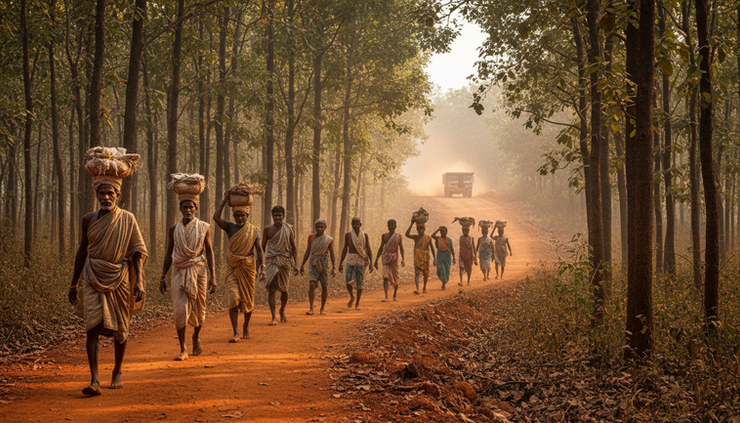
India must count the people behind the minerals
India’s extraction economy has produced electricity, steel, aluminium, revenue and infrastructure. It has also produced displacement, waiting, legal fatigue, fractured villages and deep distrust. Both truths must be held together.
The country cannot keep celebrating mineral wealth while treating Adivasi dispossession as a footnote. Jharkhand’s coal, Odisha’s iron ore and bauxite, and Chhattisgarh’s mineral belts are not just inputs for GDP. They are territories of life, law and memory.
The test of development is not how quickly a mine begins production. It is whether the people whose land makes production possible have power over the decision, a fair share in the benefits, and protection from harm.
A democratic extraction policy would start with a different order of priorities. Recognise rights first. Seek consent honestly. Compensate fully. Restore land seriously. Investigate violence independently. Treat gram sabhas as institutions of governance, not hurdles. Track displacement with the same seriousness used to track output.
India’s GDP is partially a function of mineral wealth extracted from Adivasi territories. For too long, it has not been a function of the communities whose territories made that extraction possible.
That must change. A nation that counts coal, iron ore and bauxite so carefully must also count every village moved, every promise broken, every forest right ignored, and every life made insecure in the name of progress. Development cannot be called national if its costs are made tribal.


