India's Night Shift Women — The Invisible Labour Force Running Your E-Commerce

A 10-minute delivery button feels like magic only because the warehouse is kept out of sight.
In May 2024, as Delhi and the NCR region burned through a record-breaking heatwave with temperatures reported around 49°C, workers at Amazon’s Manesar fulfilment centre were asked not to take breaks for water or toilet visits until daily targets were met. The National Human Rights Commission took suo motu cognizance of the case. Amazon later confirmed that a manager had requested the pledges as a “motivational exercise.” Haryana labour inspections found inadequate safety equipment and labour law non-compliance. Amazon was prosecuted in a Haryana court. The manager was dismissed.
The targets, according to the information available, were not reviewed.
That last sentence matters. Because the problem was never only one manager, one warehouse, or one scorching week in May. It was the collision of three forces India knows very well now: extreme heat, hyper-fast commerce, and a labour system that treats women’s bodies as adjustable parts in a delivery machine.
India’s e-commerce market is already worth around $60 billion and is projected to grow to about $160 billion by 2028. That growth is not floating in the cloud. It is packed, scanned, sorted, lifted, sealed, and dispatched by human beings in fulfilment centres, sorting hubs, dark stores, and delivery networks across the country.
Many of those workers are women. Many are on fixed-term or third-party contracts. Many come from rural or semi-urban backgrounds. Many are not working for extra pocket money, but as primary household earners.
When Amazon launched its “Women in Night Shifts” initiative, or WINS, across nine states in February 2024, the company framed night shift access as inclusion. On paper, that sounds progressive. Women should have access to jobs, shifts, wages, and mobility. But inclusion cannot mean giving women access to the same unsafe, punishing, poorly monitored conditions that already exist.
A night shift is not empowerment if the toilet is too far, the break is penalised, the transport is unsafe, and the worker is too afraid to slow down.

The Manesar case showed how fragile the promise of “safe work” can be
The Manesar incident is disturbing because it is so blunt. During a heatwave, workers reportedly faced pressure not to take water or toilet breaks until targets were met. Heat and dehydration are not minor discomforts. In an industrial setting, they can become serious occupational hazards.
This is not a complicated point. In 49°C heat, water is not a perk. A toilet break is not indiscipline. Sitting down is not laziness. These are basic needs.
The National Human Rights Commission’s intervention signalled that the matter went beyond internal HR policy. State inspections then reportedly found inadequate safety equipment and non-compliance with labour laws. The case moved to prosecution in a Haryana court. Amazon said the manager’s request was a motivational exercise and dismissed the manager involved.
That response leaves a large question hanging in the hot air: if the targets remained untouched, what exactly changed?
A target is not neutral. A target decides how fast a worker must scan, pack, walk, bend, lift, and return. It decides whether a toilet break is treated as normal or as lost productivity. It decides whether drinking water becomes a right or a risk. In a warehouse monitored by devices and software, the target can become a silent supervisor.
Workers across documented accounts of warehouse labour in India have described 9-hour shifts on concrete floors without seating, limited scheduled toilet breaks, and productivity systems that register time away from the station as a performance deficit. A worker may not need a manager shouting at her if the device in her hand has already turned her bladder into a data point.
That is why the phrase “motivational exercise” deserves scrutiny. Motivation should help people do better work. It should not ask them to suppress bodily needs under threat of missed targets.
The phrase also hides the hierarchy of risk. A manager may lose a job. A company may issue a statement. A consumer may never know the incident happened. The worker carries the physical cost in real time.
The woman who packed your order may have stood for nine hours to do it.
This is where the debate about Amazon India warehouse women workers conditions 2024 2025, NHRC Amazon Manesar toilet break heatwave, India e-commerce women night shift WINS Amazon, Factories Act toilet ratio women India 2025, India e-commerce warehouse labour law violations, Flipkart Meesho women workers contract gig becomes more than a search trend. It becomes a map of the new Indian workplace.
Fast delivery has made warehouse labour invisible by design
The 10-minute delivery guarantee is a consumer promise. The conditions under which it is fulfilled are often treated as an industrial secret.
Consumers see the app interface. They see “arriving soon.” They see discounts, memberships, return windows, and replacement guarantees. They do not see the back-end choreography of fulfilment centres, dark stores, sorting hubs, loading docks, third-party staffing agencies, and delivery workers moving through extreme weather and tight time windows.
That invisibility is not accidental. Speed works best when it feels effortless.
E-commerce platforms have trained urban India to expect the city to respond instantly. Need a charger? Ten minutes. Out of coffee? Ten minutes. Forgot detergent? Ten minutes. A simple craving becomes an urgent logistical command.
The front end is cheerful. The back end is disciplined.
Every promise of speed has a labour question inside it:
Who packed the order?
How many items did they pack per hour?
How long did they stand?
Could they drink water freely?
Could they use the toilet without anxiety?
Was the warehouse cool enough during peak heat?
Were women working nights given safe transport and secure facilities?
Did contract workers have the power to complain without losing shifts?
These questions rarely appear in advertising. They also rarely appear on checkout screens.
A warehouse is not a traditional shop. It is designed for movement, scanning, storage density, and order accuracy. Modern fulfilment centres can track inventory with striking precision. They know where a product is, where it should go, who touched it, when it moved, and whether it missed a target.
Yet welfare often receives a far less precise design.
India’s Factories Act requires one toilet for every fifty women workers. That law was written in 1948. Even if a warehouse meets the numerical ratio, the real question is whether workers can actually access the facility without penalty, delay, fear, or harassment. A toilet that exists on a compliance checklist but is unreachable within a target-driven shift does not offer dignity.
There is a sharp contrast here. The warehouses of 2026 are far more efficient in logistics design than in welfare design. A packet can be tracked across kilometres. A worker’s need to sit down can disappear into policy silence.
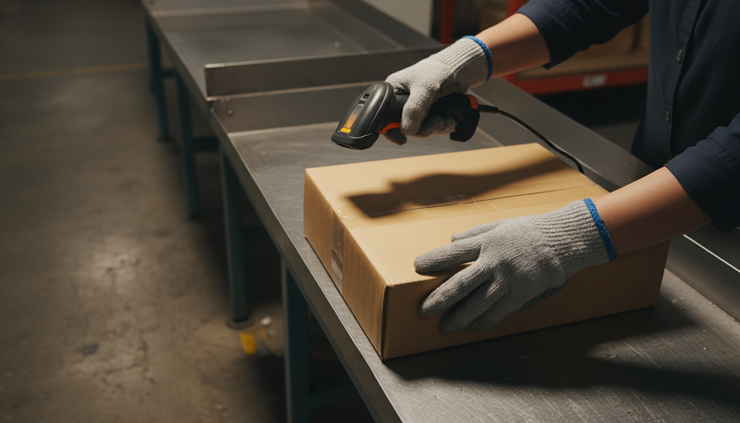
Women are being invited into warehouses without enough power over the terms
The growth of women’s employment in e-commerce logistics should be welcomed. Paid work can change household power, expand mobility, build confidence, and give women an income of their own. For many families, a warehouse job can be the difference between debt and stability.
That is exactly why the quality of these jobs matters.
Women workers in warehouses are not a single category. Some are young migrants. Some travel from nearby towns. Some are married women supporting children and parents. Some are first-generation industrial workers. Some are working because agriculture has become uncertain, local jobs are scarce, or household income has fallen. Many enter through contractors rather than direct company rolls.
A contract can decide everything. It can decide job security, complaint channels, leave, overtime, benefits, and bargaining power. When the employer on paper is a third-party agency, accountability can become blurred. The platform sets the pace. The contractor controls the attendance. The worker absorbs the risk.
This is the uncomfortable truth behind many inclusion programmes. Access is easier to announce than power is to share.
Amazon’s WINS initiative, launched across nine states in February 2024, was presented as a move to bring women into night shifts. In principle, women should not be excluded from night work simply because they are women. Blanket restrictions often limit women’s earnings and reinforce old ideas about who belongs in industrial spaces.
But safe night work needs more than permission.
It needs:
reliable transport to and from the workplace
well-lit entry and exit points
clean and accessible toilets
rest areas
clear anti-harassment systems
supervisors trained on gender-sensitive workplace conduct
predictable shift schedules
emergency medical support
freedom to report unsafe conditions without retaliation
The timing of WINS is what makes the story so revealing. The same year that women’s night work was being framed as inclusion, basic safety concerns at a fulfilment centre were under official scrutiny.
That does not mean women should be kept out of warehouses. It means warehouses must be made fit for women workers, including those who are poor, contract-based, migrant, caste-marginalised, or supporting dependents.
Inclusion cannot stop at recruitment posters. It must reach the toilet queue, the night bus, the heat protocol, the break policy, the complaint register, and the algorithm that marks time away as loss.
The body is not a productivity error
Many industrial systems treat labour as movement. Pick. Pack. Scan. Seal. Walk. Return. Repeat. The body appears only when it slows the system down.
But bodies need water. Bodies menstruate. Bodies get dizzy in heat. Bodies need toilets. Bodies need rest after standing on concrete. Bodies become unsafe when speed is pursued without recovery.
For women, these issues can carry added burdens. Menstrual hygiene depends on clean toilets, disposal systems, privacy, and enough time. Pregnancy, caregiving responsibilities, anaemia, long commutes, and safety concerns can all affect how work is experienced. None of this makes women less suited to warehouse work. It makes the workplace responsible for being designed around real human needs.
The old factory model often assumed a male worker with a wife at home handling care work. The new warehouse model hires women into intense shifts while still expecting them to return home to unpaid labour. That double load rarely appears in productivity dashboards.
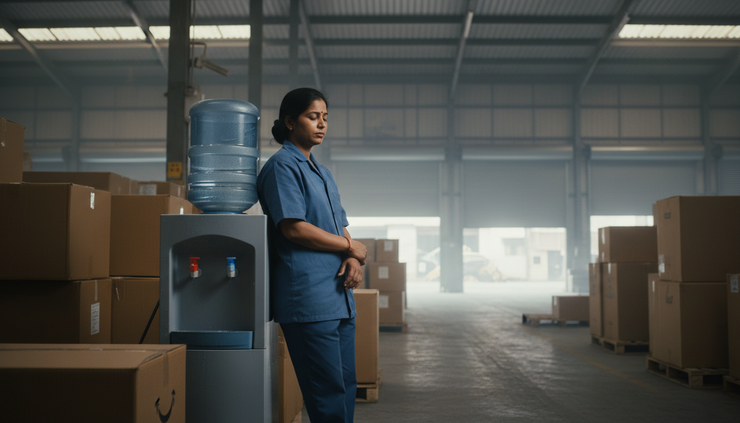
The Factories Act is too old for the warehouse India has built
India’s Factories Act, 1948, was written for a very different industrial age. It still matters. Its provisions on sanitation, welfare, working hours, safety, and basic facilities remain central to worker protection. But the modern e-commerce warehouse has changed the speed, scale, and surveillance of industrial work.
The law says one toilet for every fifty women workers. That number is important, but it is not enough.
A modern standard would ask more precise questions:
Worker need | What compliance often counts | What dignity requires |
Toilets | Number of facilities | Clean, safe, nearby toilets that workers can use without penalty |
Breaks | Scheduled break slots | Flexibility for water, heat stress, menstruation, illness, and emergencies |
Heat safety | Fans or basic ventilation | Heat action plans, cool drinking water, shaded rest, medical response, pace adjustment |
Seating | A rest area somewhere on site | Real opportunities to sit during long shifts or rotate tasks |
Night shifts | Permission to employ women | Safe transport, secure facilities, trained supervisors, complaint systems |
Productivity | Targets and attendance | Targets reviewed against safety, fatigue, heat, and human limits |
The gap between these columns is where exploitation often lives.
A company can say it follows the law while designing work that makes lawful facilities hard to use. A warehouse can have toilets but not enough break flexibility. It can have drinking water but a target system that discourages the walk to reach it. It can have a grievance channel but contract workers who fear losing shifts if they speak.
This is why labour enforcement matters. The state cannot rely on corporate self-reporting in a sector built for speed and opacity. Inspections, worker interviews, heat protocols, gender audits, and contractor accountability must become normal parts of e-commerce governance.
The Manesar case also shows why public institutions matter. The NHRC’s suo motu cognizance pushed the incident into a rights framework. Labour inspection brought state scrutiny. Prosecution signalled that compliance is not optional.
But enforcement cannot be event-based. It cannot wait for a heatwave scandal. India will face more extreme heat. Warehouses, dark stores, and delivery networks will continue expanding. The labour system needs rules that match the climate reality and the business model.
Algorithmic management needs human limits
A supervisor can be questioned. A software system is harder to argue with.
Warehouse workers often experience management through devices, dashboards, scanners, attendance systems, and target metrics. These tools can improve coordination. They can also intensify work without anyone appearing directly responsible.
If time away from a packing station counts against a worker, the system shapes behaviour. It tells workers that water is costly. It tells them that toilet breaks are risky. It turns hesitation into weak performance. It converts fatigue into data.
This is where algorithmic management needs regulation. A company should not be allowed to hide behind software when software is part of the pressure. Targets must be auditable. Break penalties must be visible. Heat-related adjustments must be documented. Workers should know how their performance is measured and how to challenge errors.
The most urgent question is simple: who checks whether the target is safe?
Not whether it is profitable. Not whether it is efficient. Not whether it pleases customers. Safe.
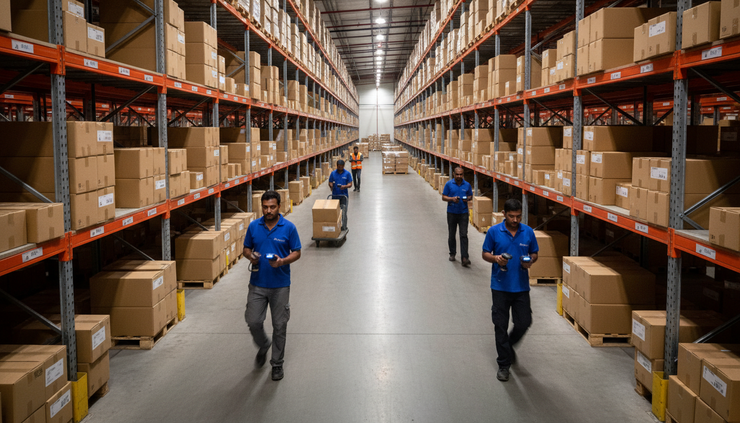
Consumers are part of the system, but companies hold the power
It is tempting to turn this into a story about individual guilt. That would be too easy and not useful enough.
A person ordering medicine, groceries, baby formula, a phone charger, or food staples is not personally managing a warehouse floor. Urban consumers did not write the staffing contracts. They did not design productivity software. They did not decide toilet access. They did not set heat protocols.
But consumer expectations do shape the market. When instant delivery becomes the default, companies compete by compressing time. Time is squeezed out of inventory, transport, storage, and labour. The squeeze falls hardest on those with the least power to refuse.
So the question is not whether consumers should stop buying online. E-commerce is now part of everyday life, and it can create real convenience, jobs, and market access. The question is what kind of convenience India is willing to normalise.
A socially conscious consumer can ask sharper questions:
Does the platform publish warehouse safety data?
Does it disclose contractor labour practices?
Are productivity targets reviewed during heatwaves?
Are women night shift workers guaranteed safe transport?
Are toilet breaks protected from performance penalties?
Does the company recognise worker complaints from contract staff?
Are injuries, heat stress cases, and labour inspections publicly reported?
Journalists can push beyond launch announcements and ask what happens inside fulfilment centres at 3 pm in May or 2 am on a night shift. Policy researchers can study the gap between written compliance and actual access. Labour rights groups can connect warehouse conditions to the wider gig and platform economy. Women’s rights advocates can insist that employment access and workplace dignity must move together.
The comparison should also widen beyond one company. Flipkart, Meesho, quick commerce platforms, logistics firms, and staffing agencies all operate in the same broad race for speed, scale, and low-cost fulfilment. Amazon’s Manesar case matters because it is specific. It also matters because it points to a sector-wide question.
India cannot build a $160 billion e-commerce future on exhausted workers who are afraid to drink water.
What better rules could look like
The path forward is not mysterious. It is practical.
India needs warehouse standards that match the real conditions of platform-era logistics. That means stronger heat safety rules, especially for NCR, north India, central India, and other regions facing extreme summer temperatures. It means mandatory rest and hydration access that cannot be overridden by daily targets. It means gender-sensitive facilities that are audited in practice, not only counted on paper.
It also means direct accountability for companies that benefit from contract labour. If a platform controls the pace, process, technology, and output, it should not be able to push responsibility down the chain when workers face unsafe conditions.
The most credible companies should welcome this. A market as large as India’s e-commerce sector cannot run on trust-me policies. It needs public standards, inspection, disclosure, and worker voice.
A serious worker safety framework would include:
heat action plans for warehouses and delivery networks
guaranteed water and toilet access outside rigid break slots
seating or task rotation for long standing shifts
menstrual hygiene facilities and disposal systems
safe transport and secure reporting for night shifts
public reporting on labour inspections and corrective action
contractor accountability tied to the principal platform
worker committees with women’s representation
review of productivity targets during heatwaves and peak sale periods
clear rules on algorithmic tracking and break penalties
These are not radical demands. They are the minimum architecture of decent work.
The true cost of instant delivery must be made visible
The story of Amazon’s Manesar fulfilment centre should stay with us because it forces a hard question into the open. What do we mean by progress if a market can deliver in minutes but cannot guarantee water, toilets, rest, and safety to the people making that delivery possible?
India’s e-commerce boom is real. It is exciting, useful, and full of possibility. It can create jobs for women who have long been kept out of paid work. It can connect small sellers to national markets. It can make urban life easier. None of that requires us to ignore the human cost of speed.
The next phase of Indian e-commerce should not be measured only by gross merchandise value, delivery time, app downloads, or festive sale records. It should be measured by whether the worker on the warehouse floor can pause without fear.
Because convenience built on silence is fragile. Inclusion without safety is branding. Productivity without dignity is exploitation with better software.
The 10-minute promise will keep glowing on Indian phones. Before tapping it, the country needs to ask what sits behind that glow: a better logistics system, or a woman standing on concrete in punishing heat, waiting until the target is met before she can drink water.


