The Deadly Sand Mafia Behind India Construction Boom

A truck running over a journalist in Bhind is not a freak accident in the story of Indian infrastructure. It is a warning flare.
In March 2018, Sandeep Sharma, a television journalist in Madhya Pradesh, died after a truck hit him. He had been reporting on alleged links between police officials and the sand mining mafia operating along the Chambal. In June 2020, Shubham Mani Tripathi of Kampu Mail was shot dead on his motorcycle in Uttar Pradesh. Before his death, he had posted online that he feared for his life because of what he had found. In 2016, two other journalists were shot dead in separate attacks in Uttar Pradesh after reporting on illegal mining.
This is the human cost hidden inside India’s concrete skyline.
River sand is the second most extracted natural resource on Earth after water. It is in the columns, plaster, flyovers, metro works, gated colonies, bridges and shopping complexes that define urban growth. India’s construction boom has turned this grainy, ordinary-looking material into a prize worth killing for.
The phrase India illegal sand mining mafia 2025 sounds like a search term, but it describes a real political economy: trucks moving at night, riverbeds stripped faster than monsoons can heal them, local officials looking away, court orders gathering dust, and reporters paying with their lives for following the trail.

Why river sand became India’s quiet gold rush
Sand looks abundant because deserts exist. That is the first mistake.
The sand used in construction is usually not desert sand. Desert grains are often too rounded and smooth to bind well in concrete. Construction needs angular grains, the kind shaped by rivers, floods and erosion over long periods. River sand has become so valuable because it is geologically useful, easy to extract, and often poorly policed.
India’s cities have been expanding at a breathtaking pace. Homes, highways, airports, warehouses, industrial corridors and metro networks all need aggregates. Cement gets the attention, steel gets the price charts, but sand is the silent bulk ingredient. A building cannot rise without it.
That demand has created a brutal incentive. If a contractor can source sand cheaply, the margins improve. If a miner can extract sand without paying royalties, following environmental limits or respecting no-mining zones, the profits rise further. The river carries the loss. The public carries the risk.
This is why illegal sand mining is rarely just a story of a few villagers with spades. In many regions, it has grown into an organised chain:
Local spotters track enforcement movement.
Excavators and tractors remove sand from riverbeds.
Trucks transport material at night or through informal routes.
Middlemen create paperwork, mix legal and illegal supplies, or move the sand into construction markets.
Political protection and intimidation keep the system running.
By the time sand reaches a construction site in a city, it may look clean and ordinary. Its origin may be opaque. A buyer sees a truckload. The river sees a wound.
The Chambal region shows how quickly extraction can overpower governance. The Chambal Sanctuary, home to fragile river habitats and species such as gharials and river dolphins in parts of the basin, has seen illegal riverbed mining with tractors and earthmovers. Reports and court proceedings have pointed to mining taking place despite the awareness of local administration, forest staff and police departments. When extraction happens in or near protected areas, it is not just a violation of paperwork. It changes channels, nesting banks, water flows and the survival chances of species already pushed to the edge.
The crisis is not confined to central India. In 2017, Tamil Nadu, Karnataka and Kerala imported roughly 54,000 to 55,000 tonnes of sand from Malaysia. That is a staggering image: coastal and river-rich states importing sand across the sea because local supply had been damaged, exhausted, restricted or captured by illegal networks. The problem was not that India had no sand. The problem was that accessible, usable, legally extractable sand had become scarce or contested.
This is the core absurdity of the boom. India is building upwards while digging its rivers hollow.
The beat can get journalists killed
Environmental journalism often sounds gentle from a distance. Trees, rivers, wildlife, climate, public health. On the ground, it can mean following money, trucks, permits and armed men.
Sand mining is one of the most dangerous beats in India because it sits at the junction of three powerful forces: infrastructure demand, local political patronage and weak enforcement. A reporter who photographs an illegal mining site may not be exposing only one contractor. They may be exposing a revenue network that feeds police posts, local strongmen, transporters, officials and political campaigns.
That is why the deaths of journalists matter beyond the press freedom community.
Sandeep Sharma’s reporting in Madhya Pradesh had focused on alleged collusion between police and the sand mafia. He had reportedly sought protection and raised concerns before his death. The image remains chilling: a journalist who had been documenting trucks and power networks dies under the wheels of a truck.
Shubham Mani Tripathi’s murder in Uttar Pradesh carried the same message of fear. He had written that he was under threat. He was killed while riding his motorcycle. The details differ from case to case, but the pattern is familiar: local journalists report on illegal extraction, land grabbing, political links or corruption, then face intimidation, assault, cases, or death.
Reporters Without Borders has documented how dangerous this beat can be. The phrase journalists killed sand mafia India is not an abstract media rights concern. It points to a democratic failure. If the person documenting a crime can be eliminated, the crime itself becomes harder to see.

Local reporters carry risks that national media often does not. They live in the same districts as the people they investigate. Their families are reachable. Their routines are known. Their social media posts, police complaints and field visits leave trails. A Delhi or Mumbai newsroom may publish a big investigation and move on. A district reporter may have to return home through the same road the trucks use every night.
This is why sand mining violence should not be treated as a law and order footnote. It is a press freedom issue, an environmental justice issue and a construction accountability issue at once.
When journalists are threatened, the public loses more than a voice. It loses the evidence chain. It loses the photographs from the riverbank, the names of the transport routes, the record of who ignored warnings, and the local memory of what the river looked like before the machines arrived.
The river pays first, then the city pays
Illegal sand mining is often described as environmental damage. That is accurate, but too mild. It is also infrastructure sabotage.
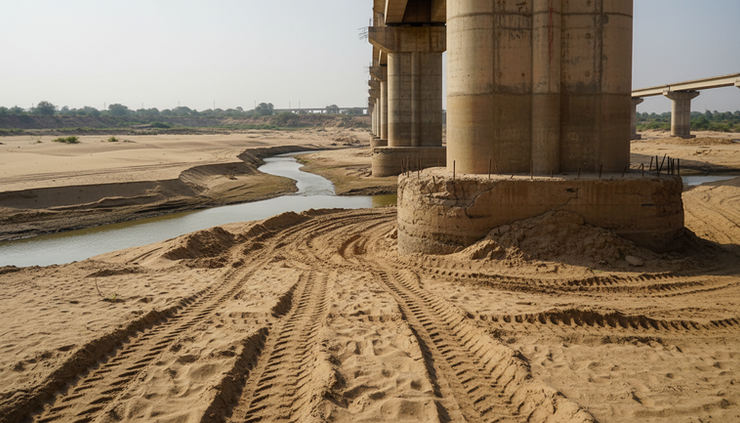
Rivers build their own stability. Sandbars, floodplains and riverbeds absorb energy, support habitats, recharge groundwater and help maintain the slope and flow of a channel. Remove too much sand and the system changes. The riverbed can deepen. Banks can collapse. Water tables can fall. Bridges can lose support around their foundations. Aquatic life loses spawning and nesting spaces.
For species in river ecosystems, this damage can be immediate. For cities, it arrives later as bills, floods, cracked structures or emergency repairs.
In 2018, four bridges, two canals and a barrage were reported damaged across India as illegal mining destabilised their foundations. This is not surprising. When miners scoop sand near bridge piers, they can worsen scouring, the process by which flowing water removes sediment around foundations. A bridge designed for one riverbed level may become vulnerable when that bed is illegally lowered.
By late 2025, Telangana offered another alarming example. Two check dams collapsed under suspicious circumstances, and local officials suspected miners had used explosives. If those suspicions are correct, the case shows how far the economics of sand can go: not just extraction, but deliberate destruction of public water infrastructure to access sediment or change local flows.
The irony is sharp. Check dams are built to store water, recharge groundwater and support rural resilience. Illegal mining can turn them into targets.
The damage also travels through the construction economy. Unregulated sand may be cheaper, but the true cost appears elsewhere:
What illegal mining saves | What the public may pay later |
Lower extraction costs for miners | River restoration and enforcement costs |
Cheaper material for some contractors | Weaker accountability in construction supply chains |
Faster local supply | Damage to bridges, canals, roads and water bodies |
Avoided royalties and permits | Lost public revenue |
Political cash flows | Threats to journalists, activists and honest officials |
The environmental case against illegal mining is not sentimental. It is practical. Rivers are infrastructure. They move water, sediment, nutrients and life. When a riverbed is stripped, a city may not notice immediately because the pain is upstream, rural or invisible. But water systems do not obey municipal boundaries. Damage in a river catchment can show up in drinking water stress, flood behaviour, biodiversity loss and repair budgets.
The construction sector should understand this better than anyone. Structures fail when foundations are compromised. Rivers do too.
The law looks strong on paper and weak on the riverbank
India does not lack environmental rules. That is part of the frustration.
Sand mining is regulated through a mix of state policies, environmental clearances, district-level assessments, court directions and National Green Tribunal orders. The system is supposed to identify where mining can happen, how much can be removed, what areas must be protected, and how extraction should be monitored.
A key document in this framework is the District Survey Report, often called a DSR. In theory, the DSR should be the scientific basis for mining decisions. It should map river stretches, estimate replenishment, identify sensitive zones, assess impacts, and guide permissions. In practice, the National Green Tribunal has repeatedly criticised state-submitted DSRs for being superficial or incomplete, including cases where reports lacked serious hydrological data.
That matters because bad data creates legal cover for bad extraction. If a DSR treats a river like a static pile of material, it misses the basic science. Rivers change by season. Sand replenishment depends on flow, floods, sediment load, upstream dams, catchment conditions and local geomorphology. A district cannot safely decide mining quantities through copy-paste reports.
This is where NGT sand mining District Survey Reports becomes more than a legal phrase. It is the hinge between science and enforcement. If the survey is weak, every clearance built on it is shaky.
Courts have issued orders. States have filed compliance reports. Committees have inspected sites. Penalties have been announced. Still, trucks keep moving.
Why? Because illegal sand mining survives through speed and protection.
A truck can load at night, move before dawn and disappear into a market before an inspection team arrives. A local official may lack staff, vehicles or political backing. Police may treat the issue as minor unless violence erupts. Honest officers can be transferred. Citizens may fear retaliation. Small miners may be caught while larger networks remain untouched.
And then there is the political economy.
Sand is local, cash-heavy and essential. That makes it attractive to power brokers. Control over sand often means control over transport routes, contracts, labour and local patronage. In some districts, anyone who asks too many questions runs into a wall of influence. This is what people mean when they speak of sand mining politicians India protection. The phrase is blunt because the reality often is.
The state’s weakness is not always absence. Sometimes it is selective presence. Police stop one tractor, while larger operators continue. A raid happens after public outrage, then extraction resumes. A report is filed, but prosecution drags. A ban is announced, but construction demand does not pause, so the illegal market fills the gap.
The law has teeth. The problem is that it often bites too late, too low and too softly.
What urban India must ask before the next tower rises
The apartment building under construction at the end of a street may rest on sand extracted illegally from a dying river. That sentence should disturb every buyer, architect, lender, developer and city planner.
Urban India loves clean renderings. Glass balconies, clubhouses, EV charging points, rooftop decks, rainwater harvesting pits, green certifications. Yet the material supply chain behind those renderings can remain murky. Sand arrives through layers of suppliers and sub-suppliers. Documentation may exist, but it may not prove much unless it can be traced to a legal source and checked against transport permits, royalty payments and approved mining limits.
For real estate buyers, this is not about becoming mining experts. It is about asking sharper questions.
A socially responsible construction project should be able to explain:
Where its sand or fine aggregate comes from.
Whether it uses manufactured sand, commonly called M-sand, where technically suitable.
How suppliers document legal sourcing.
Whether the project has internal checks for high-risk materials.
Whether contractors mix legal and illegal material in the same supply.
How the developer responds if illegal sourcing is found.
M-sand is not a magic replacement in every case. Quality matters. Standards matter. Poorly produced alternatives can create their own problems. But well-regulated manufactured sand, recycled construction material and better building design can reduce pressure on rivers. India needs a serious materials transition, not just outrage after each violent incident.
Construction industry watchers should also pay attention to procurement incentives. If tenders reward only the lowest cost and fastest delivery, illegal supply gains an advantage. If compliance is treated as a paperwork ritual, the mafia adapts. If banks, housing finance companies and large institutional buyers demand stronger material traceability, developers will respond faster than they do to moral appeals.
Cities can also act through public projects. Government agencies are major buyers of construction material. They can set standards for traceable aggregates, independent audits and penalties for illegal sourcing. Public infrastructure should not be built by hollowing out public rivers.
For researchers, the need is equally urgent. India needs better sediment budgets, district-level river monitoring, replenishment studies, drone and satellite-based tracking, and open data on mining leases and transport permits. Enforcement without science becomes arbitrary. Science without enforcement becomes a report no one fears.
For press freedom advocates, sand mining belongs at the centre of safety conversations. Local reporters covering extraction need legal support, rapid response networks, secure documentation channels and visible national attention before threats become murders. A journalist should not have to choose between publishing evidence and staying alive.

There are also signs ordinary residents can watch for near vulnerable rivers:
Excavators operating inside riverbeds outside permitted hours.
Trucks moving repeatedly at night from river access points.
Sudden deep pits, bank collapses or altered water channels.
Mining close to bridges, barrages, check dams or canals.
Threats against villagers, activists or journalists who document activity.
Local silence after obvious, large-scale extraction.
Public reporting can help, but it must be done safely. Photographing illegal mining can be dangerous. People should avoid confrontation, protect their identity where needed, and share information through trusted legal, journalistic or civic channels.
The key shift is mental. Sand is not cheap filler. It is a strategic natural resource. Treating it as endless has allowed both ecological destruction and criminal power to grow.
The takeaway is under our feet
India cannot stop building. It needs homes, transit, schools, hospitals, flood defences and climate-resilient infrastructure. The answer is not anti-development nostalgia. The answer is honest development that does not murder rivers, endanger reporters and weaken public works in the name of speed.
The sand mafia thrives because its product disappears into respectability. Stolen sand becomes a legal-looking wall. A damaged river becomes a finished apartment. A threatened reporter becomes yesterday’s headline.
That chain can be broken, but only if responsibility travels as far as the material does.
Regulators must demand scientific District Survey Reports and enforce them in the field. States must track extraction and transport in ways that cannot be gamed by night movement and false paperwork. Courts must be matched by police action and prosecution. Developers must prove sourcing, not merely claim it. Buyers must ask where the sand came from. Newsrooms must treat attacks on local environmental reporters as national stories, not district crime briefs.
The cities rising around us are not separate from the rivers being emptied to build them. Every concrete column carries a question: was this growth paid for legally, ecologically and humanely?
The journalist who would have told us the answer may already be dead. That makes the question more urgent, not less.


