India’s Coaching Gamble: Who Pays the Hidden Family Cost?

Every exam season, India counts ranks, cut-offs, toppers and seats. It rarely counts the jewellery pledged, the land mortgaged, the loan taken at high interest, or the younger sibling whose school fees were delayed because one child had to be sent to Kota, Delhi, Hyderabad, Patna, Prayagraj or Jaipur.
That missing count matters because competitive exam preparation is no longer a private academic choice. It has become a household financial strategy. For many families, especially in Bihar, Uttar Pradesh, Rajasthan, Odisha and other high-aspiration states, coaching is treated like an investment with one narrow exit: a government seat, an IIT seat, a medical seat, or a civil services rank.
The numbers show why the promise is powerful. They also show why the risk is so large.
In 2026, 18,861 candidates were allotted IIT seats after JEE Advanced, from about 2.5 lakh candidates who qualified to sit for the exam. That is roughly one in thirteen among an already filtered pool of some of India’s strongest test-takers. In the 2025 civil services cycle, 958 candidates were recommended from 9.38 lakh applicants, close to one in a thousand.
The coaching economy sells the door. India still does not audit who remains outside it.

The odds are known, but they are rarely spoken at home
Coaching decisions often begin with a sentence that sounds practical: “Let the child try for two years.” What gets hidden inside that sentence is the scale of the bet.
For elite exams, the funnel narrows at every stage. A student does not compete only with classmates. They compete with lakhs of young people who have also been selected, trained, ranked, tested and retested.
Exam pathway | Recent scale from the brief | What the number means |
JEE Advanced to IIT seat allotment | 18,861 seats from about 2.5 lakh qualified candidates in 2026 | Roughly one in thirteen among top test-takers |
Civil services recommendation | 958 recommended from 9.38 lakh applicants in the 2025 cycle | About one in a thousand applicants |
School students taking private coaching | 27 percent in government survey data | Coaching is a mainstream expense, not a niche choice |
States with very high coaching participation | Above 50 percent in Bihar and Odisha | In some regions, coaching has become close to a social norm |
These figures do not mean students should not attempt difficult exams. India needs fair pathways to engineering, medicine, public service and higher education. The issue is different. The probability of success is often understood by coaching centres better than by families paying the fees.
A rank is public. A failed attempt is private. A topper’s photograph appears on a billboard. A family’s debt does not.
That is the first distortion in India coaching culture: risk is individualised when the result is poor, but commercialised when the result is good.
The family is told to believe in effort. Effort matters. Discipline matters. Good teaching matters. But when lakhs compete for a limited number of seats, effort cannot turn every serious candidate into a selected candidate. The gap between hard work and guaranteed success is where the emotional and financial damage collects.
The family ledger has costs that no exam form records
An exam application captures a student’s name, category, centre preference and fee. It does not ask whether a parent has taken a loan. It does not ask whether a sibling moved from a private school to a cheaper school. It does not ask whether rent in a coaching town has replaced savings for healthcare or farming inputs.
Yet these are the real entries in the family ledger.
For a household sending a child away for coaching, costs can include:
Coaching fees across one or more years
Hostel, mess and transport charges
Test series, books, devices and internet
Travel between hometown and coaching city
Opportunity cost of a parent’s time
Lost earnings if a student repeats instead of entering college or work
Interest on loans from banks, relatives, moneylenders or informal lenders
Reduced spending on siblings, health, farming, housing or business needs
Some families absorb these costs with savings. Many do not. In rural and lower-middle-income households, education spending often sits beside crop risk, medical bills, weddings, rent, food prices and unstable income. Coaching converts aspiration into a fixed monthly payment.
That pressure changes family behaviour.
A younger sibling may stop asking for tuition. A parent may postpone treatment. A mother may pledge jewellery, not as a symbolic sacrifice but as working capital. A father may hide the true size of the loan. The aspirant may know enough to feel guilty, but not enough to stop.
This is why the hidden cost is not only financial. It is relational.
The debt says, “We trust you.”
The child hears, “You cannot fail.”
Those are not the same message.
Debt sharpens the fear of failure
A student from a financially secure family can treat a failed attempt as painful but recoverable. A student whose family has borrowed heavily carries a different burden. Every mock test becomes a signal about family survival. Every low rank becomes evidence of betrayal.
This is not a small psychological difference. It affects sleep, concentration, confidence and the ability to ask for help. It can also make students hide poor performance until the final result arrives.
When families borrow for coaching, the exam stops being only an exam. It becomes a repayment plan.
That does not mean parents are wrong to invest in education. For many households, education has been the most reliable path to mobility. The problem is that coaching markets present high-risk bets as if they were structured investments. In a true investment product, risk disclosures are mandatory. In coaching, the risk is explained through motivational posters.
Kota shows how quickly the market recovers
Kota has become the most visible symbol of India’s coaching economy because it concentrates every part of the model in one city: institutes, hostels, messes, test series, doubt counters, rank boards, transport, stationery shops, medical clinics and paying guest rooms.
The city has also become a symbol of stress. The phrase Kota coaching crisis now carries several meanings at once: student deaths, isolation, aggressive academic schedules, high expectations, vacant hostels after a decline in admissions, and then the return of students as the market adjusts.
The brief captures the scale of that swing. Kota moved from around 2.5 lakh students at its peak to under a lakh, while hostel owners have reported admissions rising again. That recovery tells a larger story.
The coaching machine can pause, cut prices, alter batches, increase counselling claims and start selling again. A family that sold land or took debt cannot reset so quickly.
The market counts returning admissions. Families count what was lost in the attempt.
This gap matters for policy. When a coaching hub faces a decline, the economic impact becomes visible because hostels empty, rents fall and local businesses suffer. When a family faces a decline, the effect is scattered across villages, small towns and urban bastis. There is no single dashboard.
A fall in admissions becomes news. A household’s long repayment schedule does not.
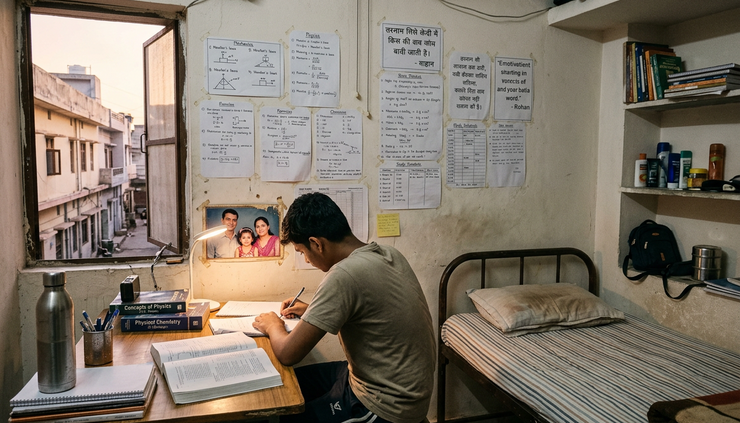
The mental health debate is necessary, but it is still too narrow
In July 2025, the Supreme Court called the coaching situation a regulatory vacuum and issued fifteen binding guidelines, mostly focused on student mental health. That intervention matters. It recognises that competitive exam preparation cannot run as an unregulated pressure system while young people carry its consequences alone.
The guidelines place attention where it is urgently needed: counselling, monitoring distress, preventing extreme academic pressure and making institutions more accountable. These are serious issues, especially in residential coaching hubs where teenagers live away from home, often for the first time.
But the mental health frame still needs to widen.
Student distress does not begin and end inside the classroom. It is shaped by the money spent before admission, the expectations set at home, the shame attached to returning without selection, and the silence that follows a result. Student mental health India discussions often focus on counselling rooms and helplines. Those are needed, but distress also lives in the family system.
A student may not say:
“My father borrowed more than he told me.”
“My sister’s college plan was delayed because of me.”
“I cannot go home unless I clear.”
“My parents do not blame me, but I can see what my failure cost them.”
“I am scared that if I stop, all the sacrifice becomes meaningless.”
These are not only academic worries. They are moral burdens. The child feels responsible for the family’s loss. The parent feels responsible for the child’s pain. Both may stay silent to protect each other.
That silence can look like discipline from the outside.
Families need support before the crisis point
Most systems respond after visible distress appears. A student misses classes. A hostel warden notices withdrawal. A test score drops sharply. A parent calls in panic. An institute counsellor steps in.
A better system would intervene earlier, before the family commits to a plan it does not fully understand.
That could include:
Clear disclosure of selection ratios by course and exam
Written estimates of total annual cost, not only tuition fees
Warnings against high-interest borrowing for uncertain outcomes
Parent orientation on realistic expectations
Regular communication that does not reduce a student to test scores
Referral pathways for mental health support outside the institute
Exit counselling for students who decide to stop or change direction
The final point is crucial. Coaching systems are built to admit students, not to help them leave with dignity. Yet a large share of aspirants will need to leave without the result they wanted. That exit should not feel like social death.
If a student changes path after one or two attempts, the family needs a plan. Without one, the result day becomes a verdict on character rather than an academic outcome.
The missing dataset is the household
India has large datasets on enrolment, exam participation, school infrastructure, higher education seats and labour market indicators. It does not have a strong national dataset on what coaching does to households.
The gap is striking because coaching is no longer a side expense. Government survey data shows 27 percent of school students take private coaching, with participation above 50 percent in states such as Bihar and Odisha. A sector at that scale affects household debt, consumption, migration, youth mental health and regional education choices.
Yet key questions remain largely unanswered at the national level:
How many families borrow for school-level or entrance coaching?
What is the average debt burden by income group?
How often do families sell assets or pledge jewellery?
How does coaching spending affect siblings’ education?
What happens to students who leave coaching without selection?
How many repeat attempts are financed through debt?
What share of aspirants enter lower-quality colleges after expensive preparation?
How often do parents receive accurate information on selection probability?
What is the long-term outcome for students who spent years preparing but did not clear?
These questions are measurable. They are not beyond the capacity of the state. They could be added to household surveys, education surveys, youth employment surveys or special studies in coaching-heavy districts.
Without this data, public debate gets trapped between two extremes.
One side says coaching creates opportunity for talented students from small towns. That is true for some students. Many first-generation learners have used coaching to enter institutions that once felt unreachable.
The other side says coaching is exploitative and harmful. That is also true in many cases, especially when institutes use fear, inflated claims or relentless testing to extract fees from families.
Both claims can be true because the system does not affect all households equally. A ₹2 lakh annual expense means one thing to an upper-middle-class family with savings. It means something entirely different to a farming household facing uncertain income or a daily-wage family with no safety net.
Data should separate these realities. Right now, they are collapsed into one word: aspiration.
The success story hides the denominator
Coaching advertising thrives on selected candidates. A front page ad may show hundreds of faces, but it rarely explains the denominator behind those faces.
How many students enrolled in the same programme?
How many were in the top batch from the start?
How many joined only a test series after already preparing elsewhere?
How many paid full fees?
How many dropped out before the exam?
How many repeated and still did not clear?
These questions matter because families use success claims to make spending decisions. If claims are incomplete, the decision is distorted.
A fairer disclosure system could require institutes to publish standardised data:
Disclosure area | What should be reported |
Enrolment base | Number of full-course students, repeaters and test-series-only students |
Selection count | Number selected from each category of enrolment |
Fee range | Total cost including tuition, tests and compulsory material |
Dropout numbers | Students who left before course completion |
Refund data | Number and share of students receiving refunds |
Support systems | Counsellor availability, referral process and escalation protocol |
Advertising basis | Whether featured rankers studied full-time, part-time or only took tests |
This would not end pressure. It would make the marketplace less opaque.
A parent buying insurance, a mutual fund or a loan receives risk information in a regulated format. A parent spending more than annual household savings on coaching often receives a brochure, a scholarship test result and a counsellor’s promise that the child has potential.
“Potential” is not a disclosure.
Parents are not irrational, they are responding to a narrow economy
It is easy to blame families for placing too much pressure on children. That view misses the structure around them.
For many households, the coaching gamble has a clear logic. Secure jobs are scarce. Public sector work still carries status, stability and social mobility. Engineering and medical seats, especially in public institutions, can sharply reduce the cost of higher education. A high rank can change a family’s future.
Parents have also seen real examples. A neighbour’s child cleared NEET and entered a government medical college. A cousin reached an IIT. A student from the district became an IAS officer. These stories travel faster than probability tables because they are personal and emotionally concrete.
The problem is that rare success becomes a planning model for everyone.
When good local schools are weak, families buy coaching. When college quality varies sharply, families chase a small set of trusted institutions. When jobs are uncertain, families chase exams with clear status. Coaching expands because it sits at the intersection of weak schooling, scarce quality seats and the hunger for stable work.
That is why moral advice alone will not solve the issue. Telling parents “do not pressure your child” is too thin when the wider economy keeps showing them that one exam can change everything.
Policy has to reduce the size of the bet. That means improving schools, expanding quality public higher education, making college outcomes more transparent, building more credible vocational and degree pathways, and improving job creation. The coaching crisis is not only an education problem. It is also a labour market problem.
The household needs a risk framework before the first fee is paid
A family does not need to be told to stop dreaming. It needs a clearer way to judge risk before the dream becomes debt.
Before committing to expensive coaching, a household should be able to answer five questions in writing.
What is the total cost for one full cycle?
The real cost includes tuition, hostel, food, travel, devices, books, tests, medical needs and emergency money. If the student is moving to another city, rent and living costs may exceed what the family first expects.
A one-year plan should include a monthly budget and a limit beyond which the family will not borrow.
What is the selection probability for this exam pathway?
The answer should use real numbers, not motivational language. For JEE Advanced and civil services, the odds are known to be steep. For NEET, too, competition for medical seats is intense. The child’s past performance, current preparation level and exam timeline should be compared honestly.
This is not to discourage effort. It is to match effort with risk.
What is the fallback plan?
A fallback plan is not a sign of weak ambition. It protects the student from feeling trapped. It may include other entrance exams, state universities, skill-based programmes, open schooling repair, online degree options, local colleges, apprenticeships or a later attempt with lower financial pressure.
The best fallback plans are discussed before the result, not after it.
What will happen if the student wants to stop?
Many families never discuss this. Then stopping feels like betrayal. A healthier plan defines conditions under which the student can pause, return home, change exams or continue through a different mode.
This protects both sides. The parent knows the investment has boundaries. The student knows love is not tied only to rank.
How will the family protect siblings and basic needs?
No exam attempt should silently consume the education of another child. If siblings’ school or college plans are being delayed, that cost should be named. If healthcare, rent or farming inputs are being compromised, that should be visible in the decision.
Families often sacrifice in silence because naming the sacrifice feels harsh. Yet unnamed sacrifice becomes resentment later.
Regulation must count more than classroom pressure
The Supreme Court’s intervention in July 2025 marks an important point. It signals that coaching cannot remain outside serious oversight. But mental health guidelines should be the start, not the full policy response.
A wider regulatory model should address four areas.
Financial transparency
Institutes should disclose total expected costs, refund rules, batch movement rules and the basis of success claims. Advertising should be standardised enough for families to compare institutes without needing insider knowledge.
Student protection
Mental health support must include trained counsellors, referral links, crisis protocols, rest norms, anti-humiliation rules and stronger hostel oversight. Students should not be publicly ranked or shamed in ways that increase distress.
Household risk tracking
Government surveys should measure education-related debt, coaching migration, asset sales, sibling impact and outcomes after failed attempts. This would give policymakers a clearer picture of family debt education India patterns.
Exit pathways
Coaching cities should have links with open universities, local colleges, skill centres and career counselling services. A student who leaves coaching should not vanish from the system. Exit should lead to another path, not a social cliff.
These reforms would not remove competition. They would reduce avoidable harm.
The real measure is not only who clears
India will continue to produce toppers. Coaching centres will continue to advertise them. Families will continue to take risks because education remains one of the few believable routes to mobility.
The question is whether the country can mature beyond celebrating the winner and ignoring the cost of the race.
A serious policy debate on the IIT JEE UPSC success rate must include the denominator. It must include the student who studied sincerely and did not clear. It must include the parent repaying a loan after the attempt ended. It must include the sibling whose choices narrowed. It must include the silence at dinner when nobody knows whether to console, blame or pretend nothing happened.
Competitive exams measure performance under pressure. They do not measure the pressure transferred to the family.
Until India counts that pressure, it will keep mistaking the coaching economy for an education system. The first step is simple: count the cost at the household level, publish the odds clearly, regulate claims honestly, and treat a student’s life after a failed attempt as seriously as the rank list after a successful one.


