How Paper Scams and Textbook Rewrites Are Stealing India’s History

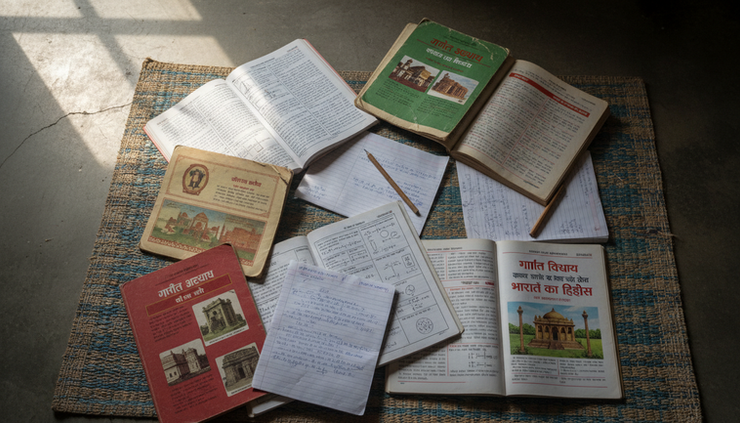
A school textbook is supposed to be one of the most ordinary objects in public life. Paper, ink, binding, a syllabus, a child’s name on the first page. Yet in India, the textbook has become something far more charged: a site where money can disappear, facts can be softened, and history can be made to behave.
The scandal is not only that children may receive bad books. The deeper scandal is that the public may never know how many hands have already shaped those books before they reach a classroom.
One hand chooses the paper vendor. Another approves the printer. Another decides the supply chain. Another revises the chapter. Another deletes the uncomfortable sentence. By the time a child opens the book on Independence Day, the text may have passed through a system that has both extracted public money and edited public memory.
The result is not a clerical problem. It is a democratic one.

The paper trail starts with public money
The Gujarat textbook paper procurement case tells a blunt story.
For around fifteen years, the Gujarat Textbook Board procured paper from a single agency at ₹107 per kg, while other suppliers were reportedly offering the same paper at ₹87 per kg. The issue surfaced publicly in 2023 and reached the High Court. In 2024, the paper was procured at ₹54 per kg.
That single number should stop everyone cold.
If the same basic input could be procured at ₹54 per kg in 2024, after years of paying ₹107 per kg, the question is not only how much was overpaid. The question is how such a gap survived for so long in a system that handles public funds, public contracts, and children’s learning material.
Fifteen years is not a procurement slip. It is an ecosystem.
A textbook board does not buy paper the way a family buys notebooks before school reopens. It works through tenders, eligibility criteria, vendor approvals, specifications, payment checks, audits, and layers of administrative sign-off. A price that remains inflated year after year suggests a failure larger than one bad decision.
It suggests that the safeguards meant to protect public money either did not work or were not allowed to work.
The reported facts raise a series of uncomfortable questions:
Why did one agency remain dominant for so long?
Why did lower offers from other suppliers not translate into lower prices earlier?
Why did it take exposure, litigation, and scrutiny for the rate to fall?
Who examined the cumulative public loss?
Why was no official prosecuted?
That last question matters. In public procurement, accountability cannot stop at the discovery of loss. If money was drained from an education system for fifteen years, the public deserves more than a corrected tender rate. It deserves responsibility.
A cheaper contract in 2024 does not repair the past. It only proves that the past needs investigation.
Textbook procurement may sound technical, but its effects are not. Every rupee lost to inflated paper prices is a rupee not spent on better distribution, improved school libraries, teacher training, updated translations, accessible formats for children with disabilities, or timely delivery to government schools.
A procurement scam does not stay inside a file. It reaches the classroom in the form of shortages, delays, thin paper, poor binding, missing stock, and inflated costs passed through the system.
And when a system learns that nobody will be prosecuted, it learns the most dangerous lesson of all: public education can be treated as a marketplace without consequences.
Scarcity creates the perfect opening for fake books
The Gujarat case is one side of the textbook economy. The other is what happens when official supply falters.
In 2025, authorities in Delhi’s Shahdara district busted a counterfeit NCERT textbook racket and seized more than 1.7 lakh fake books worth ₹2.4 crore. The scale was not minor. It pointed to organised production, storage, distribution, and demand.
Fake textbooks exist because someone can make money from them. But they thrive when official systems leave gaps.
When legitimate books are delayed or unavailable, parents still need textbooks. Schools still need children to show up with the prescribed material. Bookshops still need stock before the academic year begins. Into that pressure enters the counterfeit market, often cheaper, quicker, and easier to access.
That does not make it harmless.
A fake textbook can carry poor printing, missing pages, wrong pagination, low-quality diagrams, outdated content, or altered material. In subjects like science, history, civics, geography, and mathematics, even small errors can distort learning. For children in examination classes, errors can cost marks. For younger children, they can harden into misconceptions.
The problem is not only piracy. It is the normalisation of a parallel education supply chain.
An industry insider told PrintWeek that the core issue lay in “corruption within the ecosystem of NCERT”, both during tendering and through a parallel system of printing and distribution. The same insider reportedly noted that scarcity can sometimes be created deliberately so pirated books can fill the gap.
That allegation deserves serious public attention.
Because if scarcity is accidental, the solution is better planning. If scarcity is engineered, the problem is criminal capture.
There is a major difference between a system that fails under pressure and a system that profits from failure. In the second case, shortages are not an inconvenience. They are part of the business model.

Counterfeit rackets also expose the vulnerability of centralised textbook systems. When a single prescribed book becomes the gatekeeper for classroom learning, the demand is predictable and seasonal. If supply is late, corrupt actors know exactly when parents will panic and where schools will send them.
That makes transparency non-negotiable.
Public agencies must disclose tender details, vendor capacity, print orders, delivery schedules, shortage data, and complaint mechanisms in formats ordinary citizens can understand. School systems should not depend on whispers from bookshops or last-minute WhatsApp messages about where genuine books may be available.
A parent should be able to verify a textbook. A bookseller should not have to choose between losing customers and stocking suspicious copies. A school should not have to begin the year with incomplete material.
The fight against fake textbooks cannot end with police seizures. It has to move upstream into the procurement and distribution system that made counterfeiting profitable in the first place.
The second theft is inside the syllabus
Paper scams steal money. Counterfeit rackets steal trust. But textbook rewrites can steal something even harder to recover: the shared record of the past.
Since 2022, NCERT textbooks have seen a series of deletions and revisions that have drawn criticism from historians, scientists, educators, and civil society groups. These changes are not minor edits for length. Many concern the most contested parts of Indian history, politics, science, caste, secularism, and communal violence.
Among the reported changes:
Change | Class or subject | Why it matters |
The chapter on Mughal courts was removed | Class 12 history | It narrows exposure to a major period of Indian political, artistic, administrative, and cultural history |
Mughal and Delhi Sultanate sections were deleted | Class 7 history | It reduces medieval Indian history for younger learners at a foundational stage |
Tipu Sultan was dropped | Class 8 | It affects how students encounter anti-colonial resistance, regional politics, and contested historical memory |
References to Dalit writer Omprakash Valmiki were removed | School curriculum | It weakens the representation of caste experience and Dalit literature |
The theory of evolution was removed from Class 10 science | Class 10 science | It raised concern among scientists and educators over scientific literacy |
The phrase “minority appeasement” was introduced in a chapter on secularism | Political science | It shifts the language through which students understand constitutional values |
Babri Masjid was renamed “three-dome structure” | Class 12 political science | It changes how a central event in modern Indian politics is named |
The 2002 Gujarat riots wording was changed from “mostly Muslims” to “persons across communities” | Political science or history context | It blurs the identity of those most affected in a major episode of communal violence |
Details about Nathuram Godse’s ideological affiliations were removed | Account of Gandhi’s assassination | It changes the political context in which students understand the killing of Gandhi |
Each change can be defended by officials as rationalisation, syllabus reduction, age appropriateness, or an attempt to reduce academic burden. Some curriculum updates are necessary. No textbook should be treated as sacred. History writing evolves as new research emerges, pedagogic methods improve, and old biases are challenged.
But the pattern matters.
When deletions repeatedly move in one ideological direction, they stop looking like routine curricular trimming. They begin to look like an effort to make the past less troublesome for the present.
The removal of Mughal material does not only affect Muslim history. It affects Indian history. The Mughal period shaped architecture, revenue systems, court culture, language, painting, diplomacy, food, military organisation, and regional politics. To reduce it sharply is not to simplify history. It is to shrink the student’s map of India.
The deletion of Delhi Sultanate material from Class 7 has a similar effect. Children do not need propaganda from any side. They need proportion, context, and evidence. They need to understand that Indian history is layered, conflict-ridden, creative, violent, plural, and deeply connected across regions and communities.
A schoolbook that removes complexity may feel easier to teach. It also leaves students less prepared to understand the country they live in.
The science deletion is equally serious. The removal of evolution from Class 10 science drew protest from around 1,800 scientists and educators. Darwinian evolution is not just one topic among many. It is a foundation for modern biology. It helps explain adaptation, heredity, biodiversity, disease, ecology, and the relationship between life forms.
When students lose access to evolution at a crucial stage, the damage is not symbolic. It weakens scientific reasoning.
A country that wants world-class science cannot ration basic science in school.
The civic changes may be the most politically loaded. The phrase “minority appeasement” is not neutral language. It carries a charge from electoral politics into the classroom. Students learning secularism need to understand constitutional protection, equality before law, state neutrality, minority rights, religious freedom, and the dangers of majoritarianism. If a textbook frames minority rights through the language of appeasement, it nudges students towards suspicion rather than constitutional understanding.
Then comes the renaming of the Babri Masjid as a “three-dome structure” in Class 12 political science.
This is not a harmless architectural description. The Babri Masjid is a name with legal, historical, political, and emotional weight. It refers to a structure whose demolition in 1992 reshaped Indian politics and remains central to debates on secularism, law, memory, and majoritarian mobilisation.
Calling it a “three-dome structure” does not make the issue more neutral. It drains the event of its historical specificity.
The 2002 Gujarat riots revision is similar. Replacing a phrase that identified the victims as “mostly Muslims” with “persons across communities” changes how students read violence. Yes, people across communities suffered. But if a particular community bore the majority of deaths, naming that fact is not bias. It is accuracy.
A textbook that avoids naming who suffered most teaches students to confuse balance with erasure.
The same concern applies to the removal of details about Nathuram Godse’s ideological affiliations in the account of Gandhi’s assassination. Gandhi was not killed by an abstraction. He was killed in a political climate, by a man shaped by ideological currents. Students need that context to understand why the assassination mattered and why Gandhi’s ideas remain contested.
The issue is not whether children should be burdened with every traumatic detail. The issue is whether they should be shielded from facts that make power uncomfortable.
When textbooks rename the past, children learn silence
Every society argues about history. That is healthy. The problem begins when the state uses textbooks to settle those arguments by deletion.
A good history textbook does not ask children to memorise pride. It teaches them how to handle evidence. It shows that empires built roads and also waged wars. Reformers challenged injustice and also carried contradictions. Communities coexisted and also clashed. The Constitution promised equality in a society still marked by caste, gender, class, and religious hierarchy.
That is the real India. It is not fragile. It can survive honest teaching.
What it cannot survive is a school system that trains children to recognise only sanitised memory.

The debate over NCERT textbook changes 2024 2025 history rewritten, Babri Masjid three dome structure Class 12, textbook procurement corruption India Gujarat scam, NCERT Mughal chapter removed Class 7 12, Darwin evolution removed Class 10 India, India textbook ideology BJP curriculum rewrite is often treated as separate controversies. One belongs to education policy. One belongs to history. One belongs to science. One belongs to tendering. One belongs to law and order.
That separation is convenient, but false.
The same child experiences all of it as one system.
If the book arrives late because procurement is broken, learning suffers. If the available copy is counterfeit, learning suffers. If the official text erases key historical facts, learning suffers. If the science syllabus omits foundational concepts, learning suffers. If civic education introduces politically loaded terms without enough constitutional grounding, learning suffers.
The system does not fail in parts. It fails in the child’s hands.
And because textbooks are shared objects, the failure spreads across generations. Students who learn diluted history become adults who argue from diluted memory. Students who never study evolution properly may struggle to understand biological science later. Students who are taught to speak of communal violence without naming power and victims may grow into citizens who prefer comfort over truth.
This matters especially in a country where the school textbook often carries more authority than any other book a child will read. Many students do not have access to strong libraries, diverse reading material, or teachers with the time and freedom to correct every gap. For millions, the state-issued textbook is the main archive.
That gives the state enormous responsibility.
It also gives citizens every reason to watch textbook changes closely.
The defence of rationalisation does not answer the pattern
Supporters of syllabus reduction often make a reasonable first argument: children are overloaded. Indian students do carry too much content. Teachers often race through chapters. Exams reward memory over understanding. A leaner syllabus can help.
That argument deserves respect. But it cannot become a cover for selective amputation.
If the goal is reducing burden, cuts should follow clear academic criteria:
Is the topic repeated elsewhere?
Can the learning outcome be met through another chapter?
Does the deletion preserve chronological and conceptual balance?
Was the change reviewed by independent subject experts?
Were teachers given guidance on what changed and why?
Was public feedback invited and recorded?
A transparent process would publish the rationale for each major deletion. It would name the expert committees involved. It would explain the pedagogic reason. It would allow historians, scientists, teachers, parents, and state boards to examine the changes before they shape classroom life.
Without that transparency, “rationalisation” becomes a soft word for ideological editing.
The same principle applies to procurement. A tender may be legal on paper and still be designed to exclude competition. A vendor may meet specifications and still benefit from a rigged process. A system may conduct audits and still fail to catch patterns visible to outsiders.
Public education needs more than procedural compliance. It needs public trust.
That trust depends on open data, independent review, and consequences for wrongdoing.
The cost is paid by children who cannot object
Adults fight curriculum wars. Children inherit the results.
A Class 7 student does not know what has been removed from a chapter. A Class 10 student may not know that evolution was once part of the syllabus. A Class 12 student encountering the phrase “three-dome structure” may not realise that the naming itself is political. A child reading a softened account of 2002 may not know what has been blurred.
That is why textbook politics is so powerful. The most affected readers are least able to detect the edit.
This creates a moral duty for adults who can.
Parents can compare editions and ask schools what has changed. Teachers can document gaps and use supplementary material where allowed. Journalists can follow tenders as closely as they follow political speeches. Historians can write for the public, not only for academic journals. Scientists can keep explaining why biology without evolution is incomplete. Civil society groups can demand procurement transparency and curriculum accountability together, not as separate campaigns.
The key is to resist the temptation to treat textbook controversy as only a culture war.
It is also a governance story. It is a public finance story. It is a child rights story. It is a science education story. It is a constitutional story.
The paper scam and the rewrite belong in the same frame because both depend on opacity. One hides price. The other hides context. One benefits from tender documents few citizens read. The other benefits from syllabus changes many families notice only after the book is printed.
Both shrink the public’s ability to ask informed questions.
What accountability should look like now
India does not need textbook panic. It needs textbook democracy.
That starts with treating schoolbooks as public infrastructure. Roads, bridges, ration systems, and public hospitals draw scrutiny because they affect everyday life. Textbooks deserve the same attention. They shape how children understand the country, the Constitution, science, society, caste, gender, religion, and citizenship.
A serious accountability framework would include five steps.
First, publish procurement data in full.
Textbook boards should disclose tender notices, bidders, quoted rates, final rates, selection criteria, contract duration, quality checks, and delivery performance. This should be easy to access, not buried in documents only specialists can decode.
Second, audit long-running vendor relationships.
Any supplier receiving contracts year after year should face periodic independent review. Longevity can reflect reliability, but it can also signal cartelisation or administrative capture.
Third, track shortages publicly.
If genuine books are unavailable, citizens should know where, since when, and why. A public shortage tracker would make it harder for scarcity to be manipulated.
Fourth, create textbook verification systems that actually work.
Anti-counterfeit features, official seller lists, QR-based verification, and complaint channels can help, but only if they are simple enough for parents, students, and small booksellers to use.
Fifth, make curriculum changes transparent.
Every major deletion or rewrite should come with a public note explaining the academic reason, the experts consulted, and the expected learning outcome. The process should invite review from subject scholars, teachers, and state-level educators.
None of this is radical. It is basic public accountability.
The harder part is political will. A transparent textbook system will expose inflated contracts. It will make ideological edits easier to challenge. It will reduce the room for friendly vendors, counterfeit networks, and quiet erasures. That is exactly why it is needed.
India’s classrooms do not need perfect textbooks. No country has them. They need honest textbooks, produced through honest systems, open to correction and criticism.
Children can handle complexity. The question is whether adults can handle accountability.
A country cannot outsource its memory
The Independence Day image is powerful because it is so ordinary: a child in uniform, a flag in the schoolyard, a textbook on the desk, a lesson on freedom.
But freedom is not only a date. It is also the right to know what happened, who fought, who suffered, who governed, who resisted, who wrote, who was erased, and who paid for the book in the child’s hand.
If public money is siphoned through inflated paper contracts, the theft is financial. If fake books flood the market because scarcity is profitable, the theft is institutional. If chapters are rewritten to soften violence, erase communities, remove scientific foundations, or rename contested history into harmless shapes, the theft is intellectual.
Together, they form a larger assault on public education.
A nation’s history does not belong to a ruling party, a procurement officer, a contractor, a printer, or a curriculum committee. It belongs to the people, including the children who have not yet learned enough to demand it back.
One hand stole the paper. The other stole the history.
The task now is to make sure neither hand remains invisible.


