Climate Migrants or Just Migrants Why India Is Failing to Name the Displaced

When the sea enters a home in Mumbai, Kolkata, or the Sundarbans, it does not arrive with paperwork. It does not say whether the family leaving behind a room, a fishing net, a ration card, or a patch of farmland is an evacuee, a migrant, an encroacher, or a refugee.
The state decides that later.
On 31 August 2026, the United Nations flagged Mumbai, Kolkata, and Dhaka among the world’s megacities facing permanent inundation as seas rise nearly six millimetres a year. Fourteen million people across the three cities could lose their homes. In Mumbai alone, 60 percent of residents live in informal settlements that sit directly in the water’s path.
If they move inland, they will almost certainly not be called climate refugees. In India, they will be counted as migrants.
That distinction is not semantic. It decides whether displacement is treated as a private failure or a public emergency. It decides whether a family gets temporary shelter after a cyclone or long-term rehabilitation after permanent land loss. It decides whether a person is seen as someone chasing better wages, or someone pushed out by a climate system that has made home unliveable.
India already has climate displacement. What it lacks is a legal and statistical language honest enough to name it.

India’s climate displacement is already visible
The crisis is often described as future tense. Seas will rise. Cyclones will intensify. Droughts will become more frequent. Cities will flood.
But the movement has already begun.
Ghoramara Island in the Sundarbans is one of the clearest warnings. Two decades ago, it held around 45,000 people. Barely 2,500 remain. The rest have left as the island shrank under an advancing sea. Three neighbouring islands have been fully erased. This is not seasonal migration from a poor rural district to a city with more work. This is the disappearance of ground itself.
The Sundarbans have long lived with tides, storms, and erosion. What has changed is the scale and permanence of loss. When a cyclone hits, people may first move to a school, a shelter, or a relative’s home. When saline water poisons ponds and farmland, when embankments break again and again, when the island itself loses its edge, the move becomes something else.
Cyclone Amphan in 2020 made that clear. It displaced hundreds of thousands from the deltas of West Bengal and Bangladesh. Many who reached Kolkata entered the city’s informal economy. They became domestic workers, construction workers, rickshaw pullers, waste pickers, loaders, vendors, and day labourers. The official vocabulary had room for those roles. It had much less room for the reason they had arrived.
They were classified as informal labourers, not people fleeing a drowning home.
Bundelkhand tells the same story through drought rather than the sea. Recurring dry spells have pushed more than half the region’s four million farmers to migrate at least temporarily. In one year, 1.8 million people reportedly moved to Delhi, chasing water, wages, and survival after rainfall failed where they lived.
These movements differ in geography, caste, class, gender, duration, and destination. A fisher family leaving the Sundarbans does not face the same path as a farmer from Bundelkhand or a pavement-dweller in low-lying Mumbai. Yet they share one administrative fate. Once they cross into the city, the cause of movement fades.
The person becomes a migrant. The disaster becomes background.
India recorded 32.3 million disaster displacements between 2015 and 2024, the third-highest total in the world.
That figure should have forced a national reckoning. It should have reshaped urban planning, labour policy, housing, disaster law, and social protection. Instead, displacement is still absorbed into older categories, especially rural-to-urban migration.
That category was built for a different story. It describes movement from village to city in search of jobs, education, marriage, services, or aspiration. It cannot distinguish between someone leaving because a city offers opportunity and someone leaving because a coastline, riverbed, field, or forest can no longer support life.
This is where the debate on climate refugees India becomes politically sensitive. Refugee law usually refers to people crossing international borders because of persecution, conflict, or similar threats. Most climate-displaced Indians move within India. So the word “refugee” does not fit neatly into existing law. Yet “migrant” is too broad, too clean, and too convenient. It hides compulsion inside mobility.
The problem is not only what India calls people after a disaster. It is what the country refuses to count before the next one.

The law still treats permanent loss as temporary emergency
India’s disaster law has become better at evacuation than at recognition.
The Disaster Management Act created a framework for preparedness, response, mitigation, and institutional coordination. The system can order evacuations, run relief camps, distribute compensation, and mobilise state machinery after floods, cyclones, landslides, earthquakes, and other disasters. These tools matter. They save lives.
But they are built around an assumption: people will go back.
Evacuation is a temporary move to safety. Relief is a temporary bridge after shock. Compensation, where it arrives, is often tied to damage, death, injury, livestock loss, crop loss, or housing destruction. None of this fully addresses the permanent loss of habitability.
If a village is repeatedly flooded, if the soil turns saline, if the shoreline retreats year after year, if a delta island disappears, the issue is not evacuation. It is planned relocation, land rights, livelihood transition, urban housing, education continuity, food security, identity documents, and political representation.
The Disaster Management Act, even after amendment in 2025, still recognises evacuation more clearly than permanent climate-linked displacement. That gap matters because the state tends to help only what it can name.
Two bills introduced in Parliament in 2022 tried to create a legal category for climate migrants. They proposed a national authority and rehabilitation entitlements. Had they passed, India would at least have begun the hard work of defining who counts, what support they receive, and which level of government must act.
Both bills lapsed.
Their disappearance from the legislative agenda says something uncomfortable. India has a climate adaptation policy vocabulary. It has commitments, missions, plans, and disaster authorities. It has coastal regulations, heat action plans, cyclone shelters, and urban flood discussions. But it still has no settled rights-based framework for people whose homes become permanently unsafe because of climate stress.
The gap can be seen in the difference between three terms.
Term | What it usually assumes | What it misses |
Evacuee | A person temporarily moved from immediate danger | Permanent loss of land, housing, and livelihood |
Migrant | A person moving for work, family, education, or other reasons | Forced movement caused by environmental breakdown |
Climate-displaced person | A person compelled to move because climate stress makes home unsafe or unviable | This category has weak or no formal legal standing in India |
The absence of a category has practical effects.
A family from a washed-away island may struggle to prove residence in a new city. A woman who moved after a cyclone may lose access to local welfare records. Children may fall out of school during repeated relocation. Workers may enter hazardous informal jobs because their displacement is treated as ordinary labour mobility. People who lose land may not receive land-based compensation if the loss is gradual rather than tied to one notified event.
Slow disasters are especially difficult for law. A cyclone has a date. A flood has a visible line on a wall. Erosion, salinity, heat, groundwater decline, and drought stretch across seasons and years. They produce movement in instalments. One son leaves first. Then a cousin. Then a family sells livestock. Then the remaining household shifts after another failed crop or another breached embankment.
By the time the move looks permanent, the disaster has become administratively invisible.
That invisibility suits a system designed to handle events rather than processes. But climate change is not only an event-maker. It is a condition-changer. It changes the background on which housing, farming, fishing, water access, disease risk, and urban labour depend.
India’s legal framework has not caught up with that fact.
Cities absorb the displaced while denying the cause
Most climate-displaced people do not move into empty space. They move into cities already stretched by unaffordable housing, insecure work, poor drainage, weak public health systems, and uneven access to water.
Mumbai and Kolkata are not just vulnerable to incoming climate migration. They are themselves climate-risk zones.
This is the brutal irony. People leaving eroding islands, flood-prone villages, or drought-hit farms often arrive in cities where the cheapest housing is also the most exposed. In Mumbai, many informal settlements sit along drains, creeks, reclaimed land, mangrove edges, railway margins, and low-lying coastal stretches. These are the places where the city allows the poor to exist without fully admitting them into formal planning.
When the UN flagged Mumbai, Kolkata, and Dhaka as megacities facing permanent inundation, it was not describing a distant urban planning problem. It was describing a layered displacement crisis.
A person may move from a submerged village to a slum that floods every monsoon. A family may leave a drought-prone farm only to settle in a heat-stressed resettlement colony with unreliable water. A worker may escape cyclone damage in the delta and find employment on construction sites building sea-facing real estate.
The receiving city often reads this as pressure: pressure on housing, jobs, transport, sanitation, and services. That reading is not false, but it is incomplete. It treats migrants as the source of stress rather than as evidence of stress elsewhere.
This matters for urban policy. If arrivals are counted only as migrants, the city can respond through policing, eviction, slum clearance, labour regulation, or limited welfare. If arrivals are recognised as climate-displaced people, the response must include adaptation finance, social protection, public housing, portable entitlements, and inter-state coordination.
The difference changes what governments owe.
Portable welfare becomes central. A person fleeing a flooded district should not lose access to rations, health care, school admission, or identity-linked benefits because their address has changed. India has made progress on portability in some welfare systems, but climate displacement demands a broader design. Support must travel with the person, not remain trapped in the village they had to leave.
Housing policy also changes. Climate migrants cannot be treated only as informal encroachers. If the state knows that certain regions will produce recurring displacement, then city plans must include rental housing, serviced land, worker hostels, safe resettlement, and basic services in destination areas.
Labour protections become part of climate adaptation. Displaced people often enter city labour markets with low bargaining power. They accept unsafe work, low wages, and debt-linked arrangements because survival is immediate. A climate displacement framework would connect disaster policy with worker registration, minimum wage enforcement, occupational safety, and access to grievance systems.
Data systems need revision. Census categories, disaster records, and migration surveys should distinguish between voluntary, distress, disaster, and climate-linked movement wherever possible. This will never be perfect. People move for mixed reasons. A farmer may cite debt, crop failure, marriage, and city wages in the same sentence. But imperfect complexity is not an excuse for total blindness.
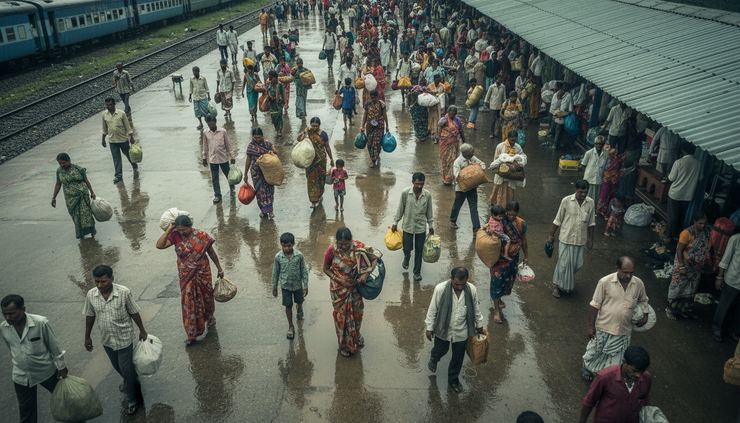
Kolkata’s experience after Cyclone Amphan displacement shows how quickly climate loss becomes urban informality. People arrive, rent a corner, find wage work, borrow money, and disappear into the city’s uncounted labour force. Relief may have been available near the disaster site. Recognition rarely survives the journey.
That is why the phrase “just migrants” is so damaging. It suggests movement alone, stripped of cause. It turns a political failure into a personal journey.
Naming climate displacement would force a harder politics
There is a reason governments hesitate to create new categories. Categories create claims.
If India formally recognises climate migrants, it must answer difficult questions.
Who qualifies? Only those displaced by sudden disasters, or also those forced out by slow-onset changes such as erosion, salinity, heat, and drought? Is proof based on place of origin, type of hazard, income loss, housing loss, or a combination? How long must displacement last before it becomes permanent? Which government pays when people move from one state to another? What happens when destination cities are also climate-vulnerable?
These are hard questions, but avoiding them does not make displacement cheaper or smaller. It only shifts costs onto the poorest households and the least prepared urban neighbourhoods.
A serious framework for climate migrants India would not need to copy international refugee law. India can build its own internal category suited to its federal structure, disaster systems, and welfare architecture. The goal should not be to create a perfect label. It should be to create a usable one.
A credible policy could begin with five elements.
A legal definition of climate-linked displacement
The definition should cover both sudden events and slow-onset processes. It should recognise that climate is often one driver among many, but still allow public authorities to identify cases where environmental change has made return unsafe or livelihood impossible.
A national registry with safeguards
India needs better data, but climate-displaced people should not be turned into targets for exclusion. Registration must protect privacy, avoid punitive policing, and connect people to services. It should help families access entitlements, not create another bureaucratic wall.
Rehabilitation beyond relief
Relief kits and temporary shelters are not enough. Rehabilitation must include housing, land where possible, livelihood support, schooling, health care, mental health services, and help replacing documents. It must also account for caste, gender, disability, age, and minority status, since displacement deepens existing inequalities.
Planned relocation before collapse
The worst time to plan relocation is after an embankment fails or a cyclone has passed. High-risk zones need anticipatory planning, community consultation, fair compensation, and safe receiving areas. Forced relocation without consent can reproduce harm. So can waiting until people have no choice left.
Urban adaptation that includes newcomers
Destination cities need finance and mandates to house and support displaced people. Climate adaptation cannot only protect airports, business districts, ports, and sea links. It must protect workers, renters, informal settlements, street vendors, and those arriving after losing homes elsewhere.
None of this is simple. But there is a moral danger in using complexity as an alibi.
The current approach pretends neutrality. It says India already records migration. It says disaster relief already exists. It says cities already manage informal labour. Yet those systems were not designed for permanent climate loss. They scatter responsibility across departments until no one owns the whole crisis.
The terminology matters because it shapes budgets. A “migrant worker” belongs to labour policy. An “evacuee” belongs to disaster response. A “slum resident” belongs to urban development. A “farmer in distress” belongs to agriculture. A “climate-displaced person” would force these systems to meet.
That is precisely why the category is needed.
The cost of silence is being paid in destination cities
India’s reluctance to name climate displacement does not stop people from moving. It only ensures they move without rights designed for their condition.
A household leaving Ghoramara does not wait for a parliamentary definition. A farmer leaving Bundelkhand does not delay departure until drought is classified as a climate trigger. A family in a Mumbai settlement facing repeated flooding does not need a global report to know the water has changed the value of home.
Policy delay creates a second displacement inside the first. People lose land or livelihood, then lose recognition. They cross into a city and find that their past has no official category. Their story is reduced to labour supply, slum growth, or urban crowding.
That reduction has consequences for journalism too. Environmental journalists and researchers often document the place of disaster with care, the breached embankment, the flooded ward, the failed crop, the damaged house. The harder task is following people after they leave. Climate displacement is not complete at departure. It continues in the rented room, the worksite, the ration queue, the school admission office, the hospital, and the eviction notice.
The same is true for policy research. Counting disaster displacements at the moment of shock is necessary, but insufficient. India needs longitudinal tracking of what happens next. Do people return? Do they move seasonally? Do they settle permanently? Do they receive compensation? Do their children stay in school? Do they obtain secure housing? Do women face greater risks after relocation? Do caste and community networks determine who survives the move with dignity?
Without these answers, large numbers can create the illusion of knowledge. The figure of 32.3 million disaster displacements between 2015 and 2024 is staggering. But unless the state knows where people went, how long they stayed, and what they lost, the number remains a warning without a policy spine.

Climate change also tests the limits of India’s development story. Rural-to-urban migration has often been framed as part of economic transition. People move from farms to cities, from low-productivity labour to higher wages, from village constraints to urban possibility. That story still exists for many. But climate disruption is adding a darker stream of movement.
Some people are not moving towards opportunity. They are moving because staying has become impossible.
Calling both groups by the same name distorts policy. It also distorts public empathy. “Migrants” are often expected to adjust, work, and endure. “Displaced people” are more likely to be seen as holding a claim against the state. That is the political charge in the word.
India does not need to import panic or fatalism. It needs administrative honesty. The country can recognise climate-linked displacement without declaring every migrant a victim. It can build thresholds, evidence standards, and review systems. It can distinguish temporary evacuation from permanent loss. It can protect people without freezing them in victimhood.
The alternative is a future where millions move under climate pressure while official India continues to describe them in categories designed for another century.
India must count what it has already created
The people arriving in Kolkata’s slums after Amphan, the families leaving the Sundarbans, the farmers moving from Bundelkhand to Delhi, and the residents of Mumbai’s low-lying settlements facing the next flood are not waiting to become a future crisis. They are the crisis as it already exists.
India’s failure is not a lack of warning. The warnings are everywhere: in erased islands, flooded lanes, failed monsoons, saline fields, heat-stressed worksites, and swelling informal settlements. The failure is the refusal to connect them under a legal and policy frame that matches reality.
A country cannot rehabilitate people it does not recognise. It cannot plan for movement it misclassifies. It cannot build climate resilience while treating the displaced as ordinary entrants into the informal economy.
The word “migrant” will remain necessary. Millions will continue to move for work, study, marriage, care, ambition, and survival. But when movement is forced by climate-linked loss, the state owes a more precise name and a stronger duty.
The sea has already named the problem. The drought has named it. The cyclone has named it. The question is whether India will.


